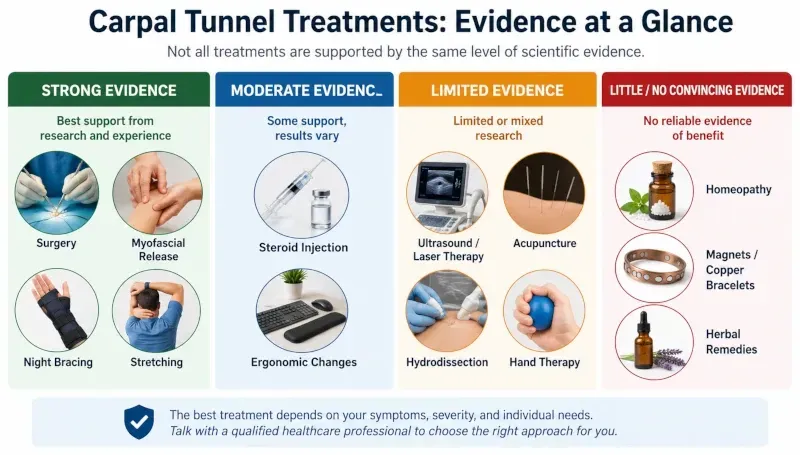
There is no permanent cure for carpal tunnel syndrome, but many treatments can produce long-term remission. The most effective options reduce pressure on the median nerve rather than simply masking symptoms. Surgery, myofascial release massage, night bracing, and stretching have the strongest evidence, while many heavily marketed "cures" have little or no scientific support.
Search online for
carpal tunnel cures and you'll find hundreds of products claiming to eliminate numbness, tingling, pain, and weakness.
Some promise overnight relief.
Others claim to regenerate nerves, dissolve scar tissue, or permanently cure carpal tunnel syndrome.
The problem is that
not all treatments deserve equal confidence.
Some have decades of scientific evidence behind them. Others have only limited research. And some are supported almost entirely by testimonials and marketing.
This guide compares today's most popular carpal tunnel treatments, explains what medical evidence says about each one, and helps you understand which options are most likely to produce lasting symptom relief.
What are the best carpal tunnel cures?
Although there is no permanent cure for carpal tunnel syndrome, several treatments can produce long-term remission by reducing pressure on the median nerve. The strongest evidence supports surgery, myofascial release massage, night bracing, and stretching exercises. Many other widely advertised "cures" have much weaker scientific support.
People Also Ask
- What is the most effective treatment for carpal tunnel syndrome?
- Can carpal tunnel syndrome be cured permanently?
- Do braces really help carpal tunnel?
- Which carpal tunnel treatments have the strongest scientific evidence?
Which Treatment Is Right for Your Stage of Carpal Tunnel?
The most effective treatment depends on how advanced your carpal tunnel syndrome has become. Find out where you stand before choosing a treatment.
Check Your Symptoms
Test Your Severity
Comparing Today's Most Popular Carpal Tunnel Cures
If you're searching for
carpal tunnel cures, you've probably discovered that there are dozens of treatment options. Some have excellent scientific support, while others rely mostly on testimonials or marketing claims.
It's important to remember that
no treatment can guarantee that carpal tunnel syndrome will never return. However, several therapies can produce long-term remission by reducing pressure on the median nerve and improving hand function.
The table below compares the most common treatments based on current medical evidence, typical effectiveness, and their role in treating carpal tunnel syndrome.
Not All "Cures" Are Created Equal
Some treatments address the underlying pressure on the median nerve, while others simply reduce pain for a short time. The treatments with the strongest evidence generally focus on relieving nerve compression rather than masking symptoms.
No single treatment is best for every patient. Mild carpal tunnel syndrome often responds well to conservative therapies, while severe or long-standing nerve compression may require surgery. The goal is choosing the treatment that matches the severity of your condition rather than simply selecting the newest or most expensive option.
How Effective Are Popular Carpal Tunnel Treatments?
| Treatment |
Evidence |
Best For |
Long-Term Results |
| Surgery
|
Strong |
Moderate to severe CTS |
Often excellent |
| Myofascial Release Massage
|
Strong |
Mild to moderate CTS |
Good with consistency |
| Night Bracing
|
Strong |
Night symptoms, mild CTS |
Good when used nightly |
| Stretching Exercises
|
Strong |
Mild to moderate CTS |
Good as part of therapy |
| Ergonomic Changes
|
Moderate |
Prevention and mild CTS |
Good for reducing recurrence |
| Steroid Injection
|
Moderate |
Temporary symptom relief |
Often temporary |
| Hydrodissection
|
Limited |
Selected patients |
Promising but not settled |
| Acupuncture
|
Limited |
Short-term relief |
Variable |
| Laser / Ultrasound Therapy
|
Limited |
Selected patients |
Variable |
| Homeopathy
|
No convincing evidence |
Not recommended |
Not established |
| Magnets / Copper Bracelets
|
No convincing evidence |
Not recommended |
Not established |
How Effective Are Popular Carpal Tunnel Treatments?
Surgery
Evidence: Strong
Best for: Moderate to severe CTS
Long-term: Often excellent
Myofascial Release Massage
Evidence: Strong
Best for: Mild to moderate CTS
Long-term: Good with consistency
Night Bracing
Evidence: Strong
Best for: Night symptoms, mild CTS
Long-term: Good when used nightly
Stretching Exercises
Evidence: Strong
Best for: Mild to moderate CTS
Long-term: Good as part of therapy
Ergonomic Changes
Evidence: Moderate
Best for: Prevention and mild CTS
Long-term: Good for reducing recurrence
Steroid Injection
Evidence: Moderate
Best for: Temporary symptom relief
Long-term: Often temporary
Hydrodissection
Evidence: Limited
Best for: Selected patients
Long-term: Promising but not settled
Acupuncture
Evidence: Limited
Best for: Short-term relief
Long-term: Variable
Laser / Ultrasound Therapy
Evidence: Limited
Best for: Selected patients
Long-term: Variable
Homeopathy
Evidence: No convincing evidence
Best for: Not recommended
Long-term: Not established
Magnets / Copper Bracelets
Evidence: No convincing evidence
Best for: Not recommended
Long-term: Not established
Treatments With the Strongest Evidence
Several treatments have consistently demonstrated meaningful improvement in clinical studies and decades of everyday use. These therapies focus on reducing pressure on the median nerve or improving tendon movement within the carpal tunnel rather than simply relieving symptoms.
Testimonials Don't Equal Scientific Evidence
People may sincerely believe a remedy helped them, but personal experiences cannot determine whether a treatment truly works. That's why researchers compare treatments with placebos in carefully controlled clinical trials.
Surgery
Surgery has the strongest evidence because it directly relieves pressure on the median nerve, particularly in moderate to severe cases. During the procedure, the surgeon divides the transverse carpal ligament to create more space within the carpal tunnel.
Most patients experience significant improvement in numbness, nighttime symptoms, and hand function. Recovery varies, but surgery is generally reserved for patients who fail conservative treatment or have advanced nerve compression.
Myofascial Release Massage
Myofascial release massage aims to improve tendon mobility, reduce adhesions, and decrease mechanical stress within the wrist and forearm. When performed correctly and consistently, many patients experience meaningful improvement in pain, stiffness, numbness, and hand function.
Unlike medications, myofascial release attempts to address one of the mechanical contributors to carpal tunnel syndrome rather than simply masking symptoms.
Night Bracing
Keeping the wrist in a neutral position during sleep reduces unnecessary pressure on the median nerve. Because many people sleep with their wrists bent, nighttime bracing often decreases numbness, tingling, and nighttime awakening.
Bracing works best when combined with other conservative treatments rather than used alone.
Stretching Exercises
Gentle tendon stretching helps maintain tendon flexibility and improves movement within the carpal tunnel. Although stretching is not a cure by itself, it can become an important part of a comprehensive treatment program when performed consistently.
Stretching appears to be most effective in mild and moderate cases and works best alongside other therapies such as activity modification and night bracing.
The Best Treatment Depends on Severity
The most effective "carpal tunnel cure" for one person may not be the best choice for another. Mild cases often respond well to conservative therapy, while advanced nerve compression may require surgery to achieve lasting relief.
Treatments With Limited Evidence
Some carpal tunnel treatments appear promising but have less scientific support than surgery, night bracing, stretching, or myofascial release massage. They may help selected patients, but the results are often inconsistent or temporary.
Steroid Injections
Corticosteroid injections can temporarily reduce inflammation around the median nerve and often provide rapid symptom relief. However, the benefit is usually temporary, lasting weeks to several months.
For many patients, injections are useful for delaying surgery or reducing symptoms during flare-ups, but they generally do not provide lasting remission.
Hydrodissection
Hydrodissection is a newer ultrasound-guided procedure that injects fluid around the median nerve to separate it from surrounding tissues.
Early studies have shown encouraging results, but long-term evidence remains limited. While hydrodissection may eventually become a more established treatment, additional high-quality research is still needed.
Laser Therapy and Therapeutic Ultrasound
Low-level laser therapy and therapeutic ultrasound have both been studied for carpal tunnel syndrome. Some patients report improvement, while others experience little benefit.
Overall, research findings remain mixed, and neither treatment has demonstrated the consistent effectiveness seen with the highest-rated therapies.
Acupuncture
Acupuncture has been investigated in numerous clinical trials. Some studies suggest modest short-term symptom improvement, but results vary considerably between patients.
Current evidence suggests acupuncture may provide temporary relief for some individuals, but it has not been shown to consistently reduce median nerve compression or produce lasting remission.
Limited Evidence Doesn't Mean "Doesn't Work"
A treatment with limited evidence may still help some people. It simply means that research has not yet demonstrated consistent benefits across large groups of patients.
Treatments With Little or No Evidence
Many products are marketed as
carpal tunnel cures, but very few have convincing scientific evidence to support their claims. These therapies are often heavily marketed despite a lack of convincing clinical evidence.
Some may produce temporary comfort, while others rely almost entirely on testimonials rather than carefully controlled clinical studies.
Vitamin Supplements
Vitamin B6 and several nutritional supplements have been promoted for decades as carpal tunnel treatments. Unless a true vitamin deficiency exists, research has generally failed to show consistent improvement from supplementation alone.
Essential Oils and Herbal Remedies
Various oils and herbal creams are advertised for nerve pain and inflammation. Although some products may create a temporary warming or cooling sensation, there is little evidence that they reduce pressure on the median nerve or improve long-term outcomes.
Homeopathy
Homeopathic remedies have not been shown to treat carpal tunnel syndrome in well-designed clinical studies. Any perceived benefit is generally attributed to placebo effects rather than the remedy itself.
Marketing Claims Are Not Scientific Evidence
Testimonials can be persuasive, but they don't replace well-designed clinical research. Before spending money on any "carpal tunnel cure," look for treatments supported by independent scientific studies rather than advertising claims alone.
Which Treatment Fits Your Stage of Carpal Tunnel Syndrome?
| CTS Stage |
Typical Symptoms |
Best Treatment Direction |
| Mild
|
Occasional numbness, tingling, nighttime symptoms |
Night bracing, stretching, myofascial release, ergonomics |
| Moderate
|
Frequent numbness, pain, hand fatigue, weaker grip |
Consistent conservative therapy; consider injection in selected cases |
| Severe
|
Constant numbness, weakness, dropping objects, sleep disruption |
Aggressive conservative therapy or surgical evaluation |
| Very Severe
|
Thenar atrophy, major weakness, advanced nerve damage |
Prompt surgical evaluation is often appropriate |
Which Treatment Fits Your CTS Stage?
Mild
Symptoms: Occasional numbness, tingling, nighttime symptoms
Treatment: Night bracing, stretching, myofascial release, ergonomics
Moderate
Symptoms: Frequent numbness, pain, hand fatigue, weaker grip
Treatment: Consistent conservative therapy; consider injection in selected cases
Severe
Symptoms: Constant numbness, weakness, dropping objects, sleep disruption
Treatment: Aggressive conservative therapy or surgical evaluation
Very Severe
Symptoms: Thenar atrophy, major weakness, advanced nerve damage
Treatment: Surgical evaluation is often appropriate
Choosing the Right Treatment
There is no single
best carpal tunnel cure for everyone. The most appropriate treatment depends largely on
how advanced your carpal tunnel syndrome has become.
Someone with mild nighttime numbness usually requires a very different approach than someone with constant numbness, thumb weakness, or muscle wasting.
In general, treatment should become more aggressive as symptoms become more severe. Starting with the least invasive option that matches your stage often provides the best balance between symptom relief and risk.
Remember that these are general guidelines. Individual factors such as age, occupation, other medical conditions, and previous treatments should always be considered when choosing a treatment plan.
Match the Treatment to the Severity
Many people choose treatments based on advertisements or online reviews. A better approach is selecting the treatment that best matches the severity of your carpal tunnel syndrome.
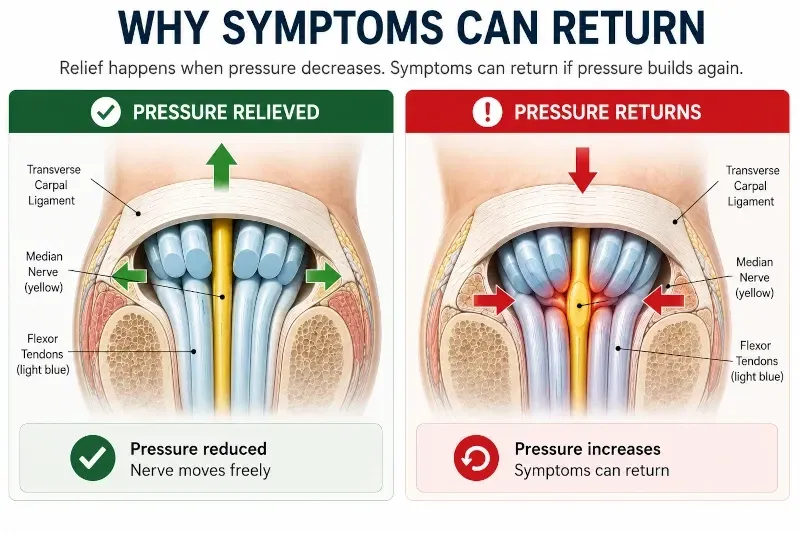
Why Symptoms Sometimes Return
Many people believe that once their symptoms disappear, their carpal tunnel syndrome has been permanently cured. Unfortunately, that isn't always the case.
Carpal tunnel syndrome is a
mechanical disorder caused by excessive pressure on the median nerve. Even after successful treatment, the activities or anatomical factors that caused the problem may still be present.
For example, symptoms may gradually return if you continue repetitive hand activities such as typing, assembly work, hairstyling, construction, gaming, or prolonged tool use without addressing the underlying stresses placed on the wrist.
Even after successful surgery, scar tissue can occasionally form, or new tissue changes may gradually recreate pressure around the median nerve. Returning to the same repetitive hand activities without modifying them increases the likelihood that symptoms will eventually recur.
The good news is that
many patients experience years—or even decades—of symptom relief following appropriate treatment. Others maintain long-term remission by continuing stretching exercises, using a nighttime brace when needed, improving workplace ergonomics, and treating early symptoms before they become severe.
The goal of treatment is not simply temporary pain relief. It's achieving the longest possible period of remission while preserving normal hand strength, sensation, and function.
Remission Is the Real Goal
Although no treatment can guarantee that carpal tunnel syndrome will never return, many therapies can provide long-lasting remission and allow patients to resume normal daily activities without symptoms.
Find the Best Treatment for Your Stage of Carpal Tunnel
Choosing the right treatment starts with knowing how advanced your carpal tunnel syndrome has become. Our free assessment tools can help guide your next step.
Check Your Symptoms
Test Your Severity
Summary
Many products are advertised as
carpal tunnel cures, but only a handful are supported by strong scientific evidence.
The treatments with the strongest evidence—such as surgery, myofascial release massage, night bracing, and stretching exercises—focus on reducing pressure on the median nerve rather than simply masking pain. Other therapies, including steroid injections and hydrodissection, may help selected patients but generally provide more limited or temporary benefits.
It's also important to understand that
no treatment can permanently guarantee carpal tunnel syndrome will never return. Even after successful treatment, symptoms can recur if the underlying stresses on the wrist continue.
For that reason, the goal should not be finding a permanent "cure," but choosing the treatment with the strongest evidence for your stage of carpal tunnel syndrome and maintaining healthy habits that reduce pressure on the median nerve.
Key Takeaways
- No treatment can permanently guarantee that carpal tunnel syndrome will never return.
- Treatments supported by stronger scientific evidence are more likely to provide consistent long-term results.
- Surgery has the strongest evidence for moderate and severe carpal tunnel syndrome.
- Myofascial release massage, night bracing, and stretching have strong evidence for many mild to moderate cases.
- Steroid injections and hydrodissection may benefit selected patients but often provide temporary relief.
- Homeopathy, magnets, copper bracelets, and many heavily marketed remedies have little or no convincing scientific evidence.
- The best treatment depends on how advanced your carpal tunnel syndrome has become.
- Long-term remission is more realistic than expecting a permanent cure.
Selected Sources
- American Academy of Orthopaedic Surgeons.
Carpal Tunnel Syndrome.
- American Society for Surgery of the Hand.
Carpal Tunnel Syndrome.
- American Academy of Neurology.
Evidence-based treatment recommendations for carpal tunnel syndrome.
- Cochrane Database of Systematic Reviews. Interventions for carpal tunnel syndrome.
- Mayo Clinic. Carpal Tunnel Syndrome.
- Johns Hopkins Medicine.
Carpal Tunnel Syndrome.
- National Institute of Neurological Disorders and Stroke. Carpal Tunnel Syndrome.
About Dr. Zannakis