

Carpal Tunnel or Fibromyalgia? How to Tell the Difference
From Dr. Z - Carpal tunnel syndrome specialist
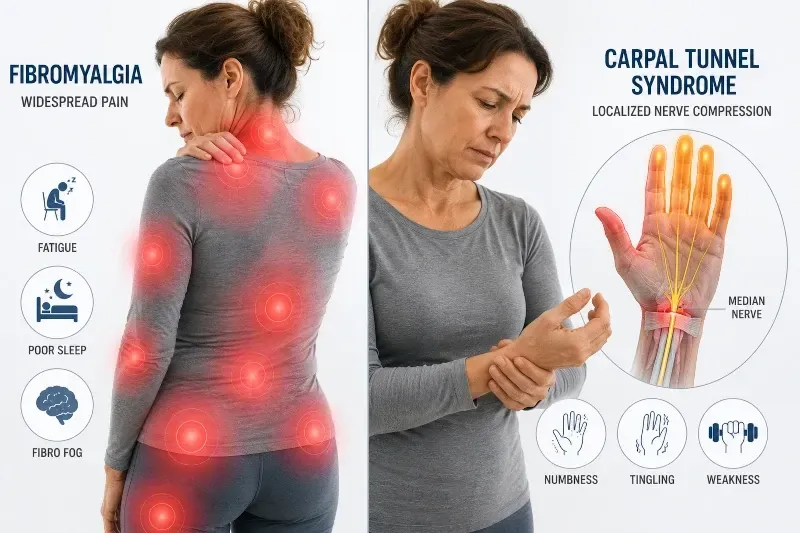
Carpal tunnel or fibromyalgia? Carpal tunnel syndrome usually causes numbness, tingling, pain, and weakness in the thumb, index finger, middle finger, and part of the ring finger. Fibromyalgia causes widespread pain, fatigue, poor sleep, and cognitive problems affecting multiple areas of the body. Although some symptoms overlap, the two disorders have different causes, different treatments, and can even occur together.
If you're wondering whether your symptoms are caused by carpal tunnel or fibromyalgia, you're not alone. Both conditions can cause hand pain, numbness, tingling, weakness, and sleep disturbances, making them easy to confuse.
The biggest difference is where the symptoms occur. Fibromyalgia is a chronic pain disorder that affects the entire body, while carpal tunnel syndrome is a localized nerve-compression disorder affecting the hand and wrist.
Fibromyalgia commonly causes widespread muscle pain, fatigue, poor-quality sleep, headaches, and difficulty concentrating ("fibro fog"). Carpal tunnel syndrome usually produces nighttime numbness, tingling, burning pain, and weakness involving the thumb, index finger, middle finger, and part of the ring finger.
Because treatment differs considerably, correctly identifying which condition is causing your symptoms is essential. Some people also develop both disorders at the same time, making an accurate diagnosis even more important.
How Can You Tell Carpal Tunnel from Fibromyalgia?
Carpal tunnel syndrome usually causes numbness, tingling, pain, or weakness affecting the thumb, index finger, middle finger, and part of the ring finger—often becoming worse at night. Fibromyalgia causes widespread pain involving multiple body regions and is commonly accompanied by fatigue, poor sleep, headaches, and fibro fog.
Table of Contents
- What Is Fibromyalgia?
- What Are the Symptoms of Fibromyalgia?
- Why Are Fibromyalgia and Carpal Tunnel Syndrome Often Confused?
- What Are the Symptoms of Carpal Tunnel Syndrome?
- Carpal Tunnel or Fibromyalgia: What Are the Main Differences?
- Can You Have Fibromyalgia and Carpal Tunnel Syndrome Together?
- How Doctors Tell Fibromyalgia from Carpal Tunnel Syndrome
- When Should You See a Doctor?
- Key Takeaways
- Summary
- About Dr. Maik Zannakis
- Medical References
People Also Ask
Can fibromyalgia feel like carpal tunnel syndrome?
Yes. Fibromyalgia may cause hand pain, numbness, or tingling. However, carpal tunnel syndrome usually produces symptoms in the thumb, index finger, middle finger, and part of the ring finger, especially at night.
How do I know if I have carpal tunnel or fibromyalgia?
The location of your symptoms provides the biggest clue. Widespread pain and fatigue suggest fibromyalgia, while recurring numbness and tingling in specific fingers strongly suggest carpal tunnel syndrome.
Can you have both fibromyalgia and carpal tunnel syndrome?
Yes. Many people develop both conditions because they have completely different underlying causes.
Which fingers go numb with carpal tunnel syndrome?
Carpal tunnel syndrome usually affects the thumb, index finger, middle finger, and thumb-side half of the ring finger. The little finger is typically unaffected.
How do doctors diagnose fibromyalgia?
Doctors diagnose fibromyalgia by evaluating widespread pain, fatigue, sleep problems, and other symptoms while ruling out other medical conditions that may cause similar complaints.
Can a nerve test diagnose fibromyalgia?
No. Nerve conduction studies diagnose disorders such as carpal tunnel syndrome. Fibromyalgia is diagnosed clinically because there is no single laboratory or imaging test that confirms it.
Could Your Hand Symptoms Actually Be Carpal Tunnel?
Many people who believe they have fibromyalgia actually have an untreated median nerve problem—or both conditions together. Our free self-tests can help determine whether your symptoms follow the classic pattern of carpal tunnel syndrome.
What Is Fibromyalgia?
Fibromyalgia is a chronic disorder that causes widespread pain and tenderness throughout the body. It is commonly accompanied by persistent fatigue, poor-quality sleep, headaches, mood changes, and difficulty thinking clearly.
Researchers believe fibromyalgia develops because the brain and spinal cord process pain signals differently than normal. As a result, sensations that would ordinarily be only mildly uncomfortable can become unusually painful.
Unlike arthritis, fibromyalgia does not primarily damage joints. Unlike carpal tunnel syndrome, it is not caused by compression of a single nerve. Instead, it affects how the nervous system interprets pain throughout the body.
People with fibromyalgia commonly describe their pain as:
- A deep, persistent ache
- Burning or throbbing discomfort
- Muscle soreness and stiffness
- Pain involving several body regions at once
- Tenderness when pressure is applied
- Symptoms that shift in location or intensity
Many people also experience fibromyalgia flares, during which pain, fatigue, sleep problems, and cognitive symptoms temporarily worsen. These flares may be triggered by stress, illness, poor sleep, excessive physical activity, or changes in routine.
Who Develops Fibromyalgia?
Fibromyalgia affects approximately 4 million adults in the United States and occurs far more often in women than men. Although symptoms commonly begin during middle adulthood, the disorder can develop at almost any age.
Researchers believe genetics, nervous-system sensitivity, physical trauma, infections, and prolonged emotional stress may all contribute to its development. No single cause has been identified.
Fibromyalgia produces widespread symptoms involving multiple body regions. Carpal tunnel syndrome is a localized nerve-compression disorder affecting the wrist and hand.
What Are the Symptoms of Fibromyalgia?
Fibromyalgia affects much more than muscles and joints. It is a complex neurological pain disorder that can produce a wide variety of physical, cognitive, and emotional symptoms. While every person experiences fibromyalgia differently, several symptoms occur consistently.
The most common symptoms include:
- Widespread muscle pain affecting both sides of the body
- Persistent fatigue, even after a full night's sleep
- Morning stiffness
- Sleep that is restless or non-restorative
- Difficulty concentrating or remembering information ("fibro fog")
- Headaches or migraines
- Increased sensitivity to touch, light, sound, heat, or cold
- Numbness or tingling in the hands and feet
- Anxiety or depression
- Digestive problems such as irritable bowel syndrome (IBS)
Perhaps the most frustrating symptom is fibro fog. People often describe slowed thinking, forgetfulness, trouble finding words, and difficulty remaining focused. Although fibro fog does not permanently damage the brain, it can significantly interfere with work, conversations, and everyday activities.
Symptoms usually fluctuate over time. During a fibromyalgia flare, pain, fatigue, and cognitive problems may become much more severe before gradually improving again.
Fibromyalgia affects approximately 4 million adults in the United States, or about 2% of the adult population. Women are diagnosed much more frequently than men, although the condition can affect anyone.
Why Are Fibromyalgia and Carpal Tunnel Syndrome Often Confused?
Fibromyalgia and carpal tunnel syndrome are frequently mistaken for one another because they share several symptoms. Both disorders may cause hand pain, numbness, tingling, weakness, and discomfort that interferes with sleep.
Despite these similarities, the underlying causes are completely different. Fibromyalgia affects how the central nervous system processes pain signals throughout the body. Carpal tunnel syndrome develops when the median nerve becomes compressed as it passes through the wrist.
Another source of confusion is that fibromyalgia can produce numbness and tingling in the hands even when no nerve is being compressed. Conversely, pain from carpal tunnel syndrome may extend into the forearm, making it appear that the problem involves the entire arm instead of just the wrist.
The overall pattern of symptoms usually provides the best clue.
- Fibromyalgia: Widespread pain involving multiple body regions, often accompanied by fatigue, poor sleep, headaches, and fibro fog.
- Carpal tunnel syndrome: Localized numbness, tingling, pain, and weakness involving the thumb, index finger, middle finger, and thumb-side of the ring finger.
Another helpful clue is that symptoms of carpal tunnel syndrome often improve temporarily after shaking or hanging the hand downward. Fibromyalgia symptoms generally do not respond to changes in wrist position.
Fibromyalgia usually causes widespread pain, fatigue, and cognitive symptoms. Carpal tunnel syndrome causes a localized pattern of numbness, tingling, pain, and weakness that follows the median nerve in the hand.

What Are the Symptoms of Carpal Tunnel Syndrome?
Carpal tunnel syndrome develops when the median nerve becomes compressed as it passes through the narrow carpal tunnel in the wrist. Unlike fibromyalgia, which may affect nearly any part of the body, carpal tunnel syndrome usually produces symptoms in a very specific and predictable pattern.
The median nerve supplies sensation to the:
- Thumb
- Index finger
- Middle finger
- Thumb-side half of the ring finger
Because of this anatomy, symptoms usually remain confined to these fingers and the palm rather than involving the entire hand.
Common symptoms include:
- Numbness or tingling in the affected fingers
- Burning, aching, or electric-shock sensations
- Hand pain that may radiate into the wrist or forearm
- Symptoms that become worse during sleep
- Temporary relief after shaking or hanging the hand downward
- Weak grip strength
- Difficulty buttoning clothing or picking up small objects
- Dropping objects unexpectedly
- Loss of thumb muscle strength in advanced cases
Symptoms usually develop gradually. Many people first notice occasional nighttime numbness before progressing to daytime tingling, persistent pain, or hand weakness if the condition continues untreated.
Unlike fibromyalgia, isolated carpal tunnel syndrome does not usually cause widespread muscle pain, chronic fatigue, headaches, or fibro fog. Those symptoms suggest a broader disorder rather than compression of a single nerve.
Repeated nighttime numbness affecting the thumb, index finger, middle finger, and thumb-side of the ring finger is one of the strongest clinical clues for carpal tunnel syndrome.
Carpal Tunnel or Fibromyalgia: What Are the Main Differences?
When trying to determine whether your symptoms are caused by carpal tunnel or fibromyalgia, physicians focus on the overall pattern rather than any single symptom.
Fibromyalgia is a disorder of abnormal pain processing that commonly produces widespread pain, fatigue, poor sleep, and cognitive symptoms. Carpal tunnel syndrome is a localized nerve-compression disorder involving the median nerve inside the wrist.
One of the most important distinctions is where the symptoms occur. Fibromyalgia usually affects several body regions simultaneously, while carpal tunnel syndrome remains centered in the wrist and the fingers supplied by the median nerve.
Other clues include whether symptoms worsen at night, whether shaking the hand provides temporary relief, whether the little finger is affected, and whether generalized fatigue or fibro fog is also present.
The comparison below summarizes the major differences between these two disorders.
Fibromyalgia vs. Carpal Tunnel Syndrome at a Glance
Fibromyalgia
- ✓ Widespread body pain
- ✓ Persistent fatigue
- ✓ Poor-quality sleep
- ✓ Fibro fog
- ✓ Symptoms affect multiple body regions
Carpal Tunnel Syndrome
- ✓ Localized wrist and hand symptoms
- ✓ Nighttime numbness and tingling
- ✓ Weak grip and dropping objects
- ✓ Median nerve compression
- ✓ Symptoms follow specific fingers
The comparison table below explains these differences in greater detail.
Although the comparison table summarizes the major differences, real-life cases are not always clear-cut. Some people experience overlapping symptoms, while others develop both disorders simultaneously. This is why healthcare providers evaluate the entire pattern of symptoms instead of relying on any single complaint.
For example, a person who experiences widespread muscle pain, persistent fatigue, poor sleep, headaches, and occasional hand tingling is more likely to have fibromyalgia. In contrast, someone who repeatedly awakens at night with numbness in the thumb, index finger, and middle finger—and experiences temporary relief after shaking the hand—is much more likely to have carpal tunnel syndrome.
Weakness also differs between the two conditions. Fibromyalgia may leave a person feeling generally tired or physically exhausted, but it rarely causes the thumb muscle weakness that develops after prolonged compression of the median nerve. Progressive loss of grip strength or shrinking of the muscles at the base of the thumb strongly suggests advanced carpal tunnel syndrome.
When deciding between carpal tunnel or fibromyalgia, physicians also consider whether symptoms are widespread or localized, whether they fluctuate throughout the body, and whether they follow the characteristic distribution of the median nerve.
The location of your symptoms is often just as important as the symptoms themselves. Widespread body pain points toward fibromyalgia, while recurring numbness affecting specific fingers strongly suggests carpal tunnel syndrome.
Can You Have Fibromyalgia and Carpal Tunnel Syndrome Together?
Yes. In fact, many people have both disorders.
Having fibromyalgia does not protect you from developing carpal tunnel syndrome. Likewise, being diagnosed with carpal tunnel syndrome does not rule out fibromyalgia. Because the two conditions have completely different causes, they may occur independently or at the same time.
This combination can make diagnosis more challenging. Someone with fibromyalgia may assume that new hand numbness or tingling is simply another manifestation of their chronic pain disorder, delaying evaluation for carpal tunnel syndrome. Conversely, a person whose carpal tunnel syndrome has been successfully treated may continue to experience widespread pain and fatigue because those symptoms originate from fibromyalgia rather than the wrist.
Doctors evaluate each condition separately. Fibromyalgia is diagnosed primarily by recognizing its characteristic pattern of widespread symptoms after excluding other medical conditions. Carpal tunnel syndrome is diagnosed through a careful history, physical examination, and, when necessary, nerve conduction studies or electromyography (EMG).
Recognizing both disorders is important because each requires a different treatment strategy. Treating only one condition may leave many symptoms unresolved if the second disorder is overlooked.
Never assume persistent hand numbness is caused solely by fibromyalgia. New or worsening symptoms should always be evaluated to determine whether carpal tunnel syndrome or another nerve disorder is also present.

Key Takeaways
- Fibromyalgia causes widespread symptoms. Pain, fatigue, poor sleep, and fibro fog commonly affect multiple areas of the body.
- Carpal tunnel syndrome is a localized nerve disorder. Symptoms usually involve the thumb, index finger, middle finger, and thumb-side of the ring finger.
- Nighttime finger numbness strongly favors carpal tunnel syndrome. Widespread body pain favors fibromyalgia.
- The two disorders may occur together. Having one condition does not rule out the other.
- An accurate diagnosis is essential. Fibromyalgia and carpal tunnel syndrome require very different treatment approaches.
Still Wondering: Carpal Tunnel or Fibromyalgia?
Fibromyalgia is more likely if you have:
- Widespread body pain
- Persistent fatigue
- Poor-quality sleep
- Fibro fog
- Symptoms affecting several body regions
Carpal tunnel syndrome is more likely if you have:
- Nighttime numbness and tingling
- Symptoms mainly in the thumb, index, and middle fingers
- Relief after shaking your hand
- Weak grip or dropping objects
- Progressive hand weakness
If you recognize features from both columns, you may have fibromyalgia and carpal tunnel syndrome simultaneously. Your healthcare provider can determine whether one—or both—conditions are contributing to your symptoms.
Summary
Determining whether your symptoms are caused by carpal tunnel or fibromyalgia depends primarily on where your symptoms occur and what other problems accompany them.
Fibromyalgia is a chronic pain disorder characterized by widespread pain, fatigue, poor-quality sleep, and cognitive difficulties known as fibro fog. Carpal tunnel syndrome develops when the median nerve becomes compressed inside the wrist, producing numbness, tingling, pain, and weakness in a characteristic pattern involving specific fingers.
Although the two disorders share several symptoms, the overall pattern usually distinguishes one from the other. Widespread body pain favors fibromyalgia, whereas recurring nighttime numbness affecting the thumb, index finger, middle finger, and thumb-side of the ring finger strongly suggests carpal tunnel syndrome.
Some people have both conditions. Because treatment differs considerably, obtaining an accurate diagnosis is the first step toward finding lasting relief and preventing unnecessary progression of either disorder.
Think You Have Carpal Tunnel?
If your symptoms include nighttime numbness, tingling, burning, or weakness of the hand, compare your symptoms with the classic pattern of carpal tunnel syndrome using our free online tools.
About Dr. Maik Zannakis
Dr. Maik Zannakis is the Medical Director of CarpalRx and a soft-tissue injury specialist with decades of experience diagnosing and treating repetitive strain injuries and peripheral nerve disorders. He has authored more than 120 medical articles focused on carpal tunnel syndrome, nerve compression disorders, and nonsurgical treatment options.
His goal is to help patients understand the true cause of their symptoms so they can make informed decisions about diagnosis, treatment, and long-term recovery.
Learn more about Dr. Zannakis and the CarpalRx team by visiting our About Us page.
Medical References
The following resources were used in preparing this article and provide additional evidence-based information about fibromyalgia and carpal tunnel syndrome.
Government & Professional Organizations
- Centers for Disease Control and Prevention (CDC). Fibromyalgia.
- National Institute of Arthritis and Musculoskeletal and Skin Diseases (NIAMS). Fibromyalgia.
- American Academy of Orthopaedic Surgeons (AAOS). Carpal Tunnel Syndrome Clinical Practice Guideline.
- American Society for Surgery of the Hand (ASSH). Carpal Tunnel Syndrome.
- National Institute of Neurological Disorders and Stroke (NINDS). Carpal Tunnel Syndrome Fact Sheet.
Peer-Reviewed Medical Literature
- Fibromyalgia: Current Concepts and Future Directions. Current Opinion in Rheumatology.
Patient Education Resources
- Healthline. Parting the Clouds: Dealing with Fibro Fog.
- Medical News Today. Fibromyalgia: Symptoms, Causes, Diagnosis, and Treatment.