

de Quervain's Syndrome: Symptoms, Causes, Treatment & Recovery
From Dr. Z - Carpal tunnel syndrome specialist
What Is de Quervain's Syndrome?
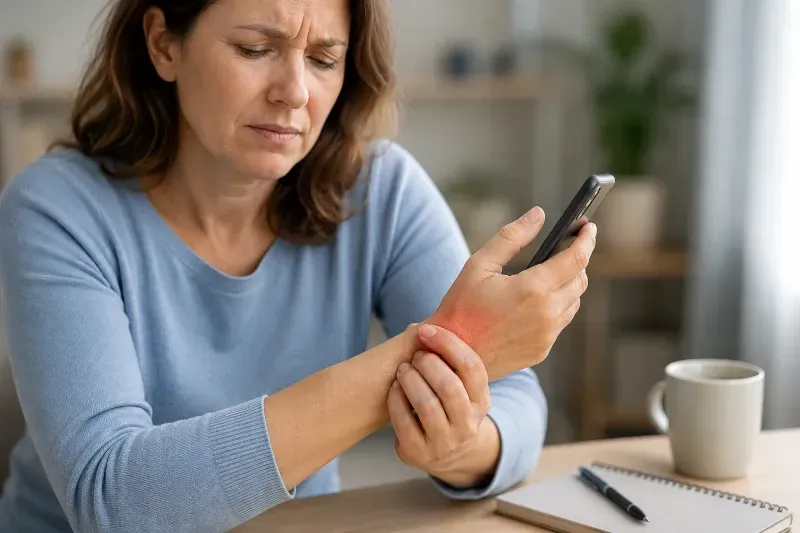
De Quervain's syndrome is a painful condition affecting the tendons on the thumb side of the wrist. It commonly causes pain when gripping, pinching, lifting, texting, or moving the thumb. Unlike carpal tunnel syndrome, it usually does not cause numbness or tingling because it affects tendons rather than a compressed nerve.
Does your thumb hurt when you text, grip a jar, lift a child, or twist your wrist? If the pain is concentrated near the base of the thumb while the rest of your hand feels relatively normal, you may have de Quervain's syndrome.
This common tendon disorder affects two thumb tendons where they pass through a narrow tunnel on the thumb side of the wrist. Because the pain occurs near the wrist, many people mistakenly assume they have carpal tunnel syndrome or general wrist tendonitis.
Fortunately, most cases improve with early treatment, temporary activity modification, and proper thumb support. Surgery is usually reserved for patients whose symptoms persist despite conservative treatment.
Featured Snippet
De Quervain's syndrome is inflammation and narrowing of the tendon sheath surrounding two thumb tendons on the thumb side of the wrist. It causes pain when moving the thumb, gripping, pinching, lifting, texting, or twisting the wrist. Unlike carpal tunnel syndrome, numbness and tingling are uncommon because the condition affects tendons instead of the median nerve.
Table of Contents
- What Is de Quervain's Syndrome?
- Other Names
- Symptoms
- de Quervain's vs. Carpal Tunnel Syndrome
- What Causes de Quervain's Syndrome?
- How Doctors Diagnose It
- Treatment Options
- When Steroid Injections May Help
- When Surgery May Be Needed
- How to Reduce the Risk of Symptoms Returning
- Summary
- About Dr. Maik Zannakis
- Medical References
People Also Ask
Is de Quervain's syndrome the same as carpal tunnel syndrome?
No. De Quervain's syndrome affects thumb tendons, while carpal tunnel syndrome results from compression of the median nerve.
Can texting cause de Quervain's syndrome?
Heavy texting and prolonged smartphone use can contribute by repeatedly stressing the thumb tendons.
What does de Quervain's pain feel like?
Most people experience aching or sharp pain on the thumb side of the wrist that worsens with gripping, pinching, lifting, or thumb movement.
Can de Quervain's syndrome heal without surgery?
Yes. Most patients improve with activity modification, thumb support, and other conservative treatments.
Think You May Have Carpal Tunnel Instead?
Thumb-side wrist pain usually suggests de Quervain's syndrome. Numbness, tingling, nighttime symptoms, or fingers falling asleep are much more consistent with carpal tunnel syndrome.
What Is de Quervain's Syndrome?
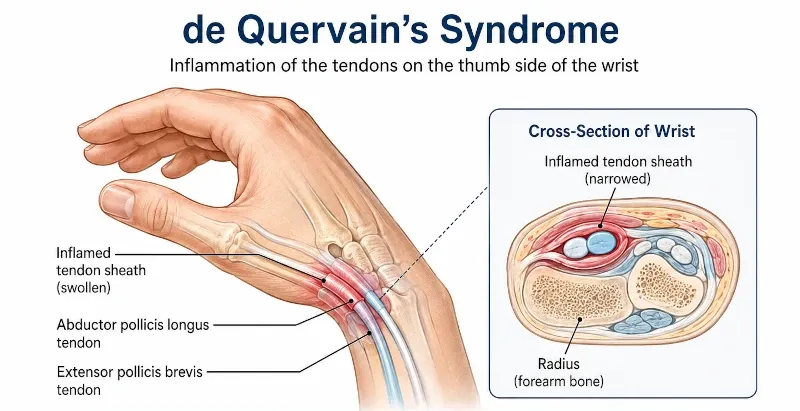
De Quervain's syndrome is a form of stenosing tenosynovitis. It affects the abductor pollicis longus (APL) and extensor pollicis brevis (EPB) tendons as they pass through a narrow tunnel on the thumb side of the wrist.
Normally these tendons glide smoothly inside a protective sheath. When the sheath becomes irritated and thickened, tendon movement becomes restricted, producing pain with thumb motion, gripping, lifting, pinching, and twisting.
de Quervain's Syndrome at a Glance
- Pain is located on the thumb side of the wrist.
- Gripping, pinching, lifting, and thumb movement worsen symptoms.
- Swelling and tenderness may develop near the base of the thumb.
- Numbness and tingling are usually absent.
- Most patients recover without surgery.
Other Names for de Quervain's Syndrome
Over the years, de Quervain's syndrome has acquired several medical and descriptive names. Some refer to the anatomy involved, while others reflect activities commonly associated with the condition.
- de Quervain's tenosynovitis
- de Quervain's disease
- Radial styloid tenosynovitis
- Mother's wrist
- Mommy thumb
- Texting thumb
- Gamer's thumb
- BlackBerry thumb
Although these names emphasize different causes or activities, they all describe the same underlying tendon disorder.
Symptoms of de Quervain's Syndrome
The hallmark symptom is pain at the base of the thumb or along the thumb side of the wrist. Symptoms typically worsen with gripping, pinching, lifting, opening jars, texting, gaming, or making a fist.
Other symptoms may include swelling, tenderness, catching or snapping of the thumb, pain extending into the forearm, and reduced thumb movement due to pain.
One Important Difference
Unlike carpal tunnel syndrome, de Quervain's syndrome rarely causes numbness, tingling, electric-shock sensations, or fingers falling asleep because the median nerve is not compressed.
de Quervain's Syndrome vs. Carpal Tunnel Syndrome
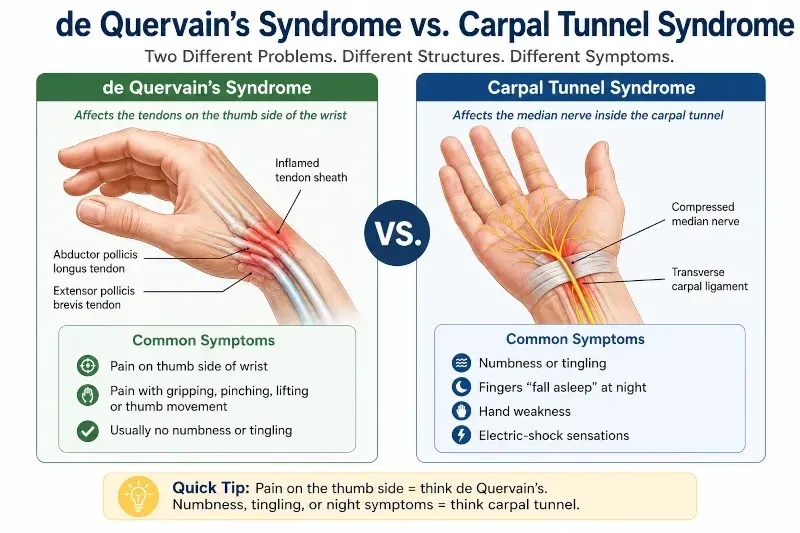
Because both conditions affect the wrist, many people assume they're the same disorder. In reality, they involve completely different tissues and produce different symptoms. Understanding those differences is important because the treatments are not the same.
De Quervain's syndrome affects the tendons on the thumb side of the wrist. Carpal tunnel syndrome develops when the median nerve becomes compressed inside the carpal tunnel. Although both can interfere with gripping and daily activities, the pattern of symptoms is usually quite different.
de Quervain's Syndrome
- Pain on the thumb side of the wrist
- Pain with gripping or pinching
- Pain during thumb movement
- Localized tenderness or swelling
- Usually no numbness or tingling
Carpal Tunnel Syndrome
- Numbness and tingling
- Nighttime symptoms
- Fingers "fall asleep"
- Hand weakness
- Electric-shock sensations
Quick Tip
Pain that stays on the thumb side of the wrist usually points toward de Quervain's syndrome. Numbness, tingling, nighttime symptoms, or fingers falling asleep are much more typical of carpal tunnel syndrome.
What Causes de Quervain's Syndrome?
The exact cause isn't always known. In most people, the condition develops after repeated irritation of the thumb tendons as they pass through a narrow tunnel on the thumb side of the wrist. Over time, the tendon sheath thickens, leaving less room for the tendons to glide normally. The resulting friction causes pain whenever the thumb moves.
Symptoms often appear gradually after weeks or months of repetitive thumb use, although they may also develop after a minor wrist injury or a sudden increase in activity.
Common Risk Factors
- Frequent smartphone texting or scrolling
- Repeated thumb pinching or gripping
- Lifting infants or young children
- Gardening and pruning
- Golf, rowing, racquet sports, and weight training
- Knitting, quilting, sewing, and other crafts
- Assembly-line work or repetitive manual labor
- Pregnancy and the postpartum period
Who's Most Likely to Develop It?
De Quervain's syndrome is most common in adults between 30 and 60 years of age and occurs more frequently in women. New parents, healthcare workers, musicians, gardeners, athletes, and people whose jobs require repetitive thumb motion have a higher risk.
Can Smartphones Cause de Quervain's Syndrome?
Heavy smartphone use has become one of the best-known contributors to de Quervain's syndrome. Texting, scrolling, gaming, and one-handed phone use require repeated thumb movements that can overload the thumb tendons over time.
Fortunately, smartphones are rarely the only cause. Most patients develop symptoms from a combination of repetitive thumb activities performed over weeks or months. Taking regular breaks, alternating hands, and limiting prolonged one-handed phone use can help reduce tendon strain.
Think Your Symptoms Might Be Carpal Tunnel Instead?
Thumb-side wrist pain is typical of de Quervain's syndrome. If you also experience numbness, tingling, nighttime symptoms, or hand weakness, carpal tunnel syndrome becomes much more likely.
How Doctors Diagnose de Quervain's Syndrome
De Quervain's syndrome can usually be diagnosed during a routine office visit. In most cases, imaging tests such as X-rays or MRI scans are unnecessary because the diagnosis is based primarily on your symptoms and a physical examination.
Your doctor will ask where the pain is located, which activities make it worse, and whether you have numbness, tingling, or nighttime hand symptoms. These questions help distinguish de Quervain's syndrome from carpal tunnel syndrome, thumb arthritis, wrist tendonitis, ligament injuries, and other causes of thumb-side wrist pain.
The Finkelstein Test
The most commonly used examination is the Finkelstein test. You place your thumb across your palm, wrap your fingers over it, and gently bend the wrist toward the little finger. A sharp pain along the thumb side of the wrist strongly suggests de Quervain's syndrome.
Although the test is highly useful, it is only one part of the examination. Your healthcare provider also evaluates tenderness over the tendon sheath, thumb strength, wrist motion, and other findings before making the diagnosis.
Why Imaging Usually Isn't Needed
Most patients do not need X-rays, MRI scans, or ultrasound. Imaging is generally reserved for situations where another condition is suspected or when symptoms fail to improve as expected.
Treatment Options
Most people recover without surgery. Treatment focuses on reducing irritation of the thumb tendons, allowing the tendon sheath to heal, relieving pain, and gradually restoring comfortable movement.
Early treatment is important because mild cases often respond much more quickly than long-standing or severe symptoms.
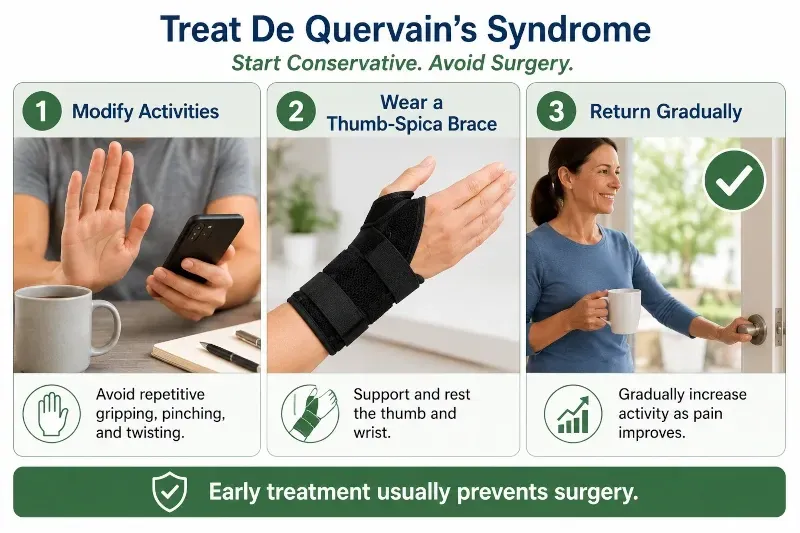
Modify Activities
The first step is identifying the activities that repeatedly irritate the thumb tendons. Temporarily reducing texting, gaming, forceful gripping, lifting, gardening, crafting, or repetitive work allows inflammation to settle and prevents further injury.
This doesn't mean complete rest. Gentle movement is encouraged, but painful activities should be reduced until symptoms improve.
Wear a Thumb-Spica Splint
A thumb-spica brace is one of the most effective first-line treatments for de Quervain's syndrome. Unlike a standard wrist brace, it stabilizes both the thumb and wrist, limiting the movements that repeatedly irritate the inflamed tendons.
Depending on your symptoms, your healthcare provider may recommend wearing the brace during aggravating activities, while sleeping, or throughout much of the day during the early stages of recovery. It should fit snugly enough to provide support without causing numbness or discomfort.
Not all thumb braces provide the same level of support. If you're unsure which style is appropriate, see our guide on how to choose the best thumb brace, including when a thumb-spica brace is recommended for de Quervain's syndrome.
Choose the Right Brace
A standard wrist brace leaves the thumb free to move and usually doesn't provide enough support for de Quervain's syndrome. A properly fitted thumb-spica brace limits painful thumb motion while allowing most finger movement.
Heat, Ice, and Medication
Ice may help reduce pain and swelling during an acute flare, while gentle heat often improves comfort once severe inflammation has settled. Some patients also benefit from over-the-counter anti-inflammatory medications, provided they are medically appropriate and approved by their healthcare provider.
Hand Therapy
Persistent symptoms may benefit from guided stretching, strengthening, and activity modification under the supervision of a hand therapist. Therapy focuses on restoring comfortable thumb movement while minimizing repeated tendon irritation.
Most Cases Improve Without Surgery
When treated early, most patients recover with activity modification, thumb support, and gradual rehabilitation. Surgery is usually considered only after conservative treatment has failed.
Think You May Have Carpal Tunnel Instead?
Pain near the thumb usually points toward de Quervain's syndrome. If numbness, tingling, nighttime symptoms, or hand weakness are your primary complaints, carpal tunnel syndrome is more likely.
When Steroid Injections May Help
If rest, activity modification, and a thumb-spica brace do not provide adequate relief, your doctor may recommend a corticosteroid injection. The medication is injected into the tendon sheath surrounding the irritated thumb tendons to reduce inflammation and allow smoother tendon movement.
Many patients experience substantial improvement after a single injection, particularly when treatment is started early. Others may require a second injection if symptoms persist or recur.
Possible side effects include temporary soreness at the injection site, skin discoloration, thinning of the tissue beneath the skin, infection, tendon injury, or a temporary rise in blood sugar in people with diabetes. Fortunately, serious complications are uncommon.
Pain Relief Doesn't Mean Complete Healing
A steroid injection reduces inflammation but doesn't eliminate the original cause of the tendon irritation. Returning too quickly to forceful gripping, childcare, gaming, sports, or repetitive thumb activity can cause symptoms to return.
When Surgery May Be Needed
Fortunately, only a small percentage of patients require surgery. Most recover with conservative treatment or corticosteroid injections. Surgery is generally reserved for persistent symptoms that continue to interfere with work, hobbies, or daily activities despite appropriate nonsurgical care.
Your doctor may recommend surgery if:
- Pain remains severe despite several months of conservative treatment.
- Thumb motion continues to be significantly restricted.
- One or more steroid injections have failed to provide lasting relief.
- The tendon sheath has become severely thickened or constricted.
- Daily activities remain limited by persistent pain.
What Happens During Surgery?
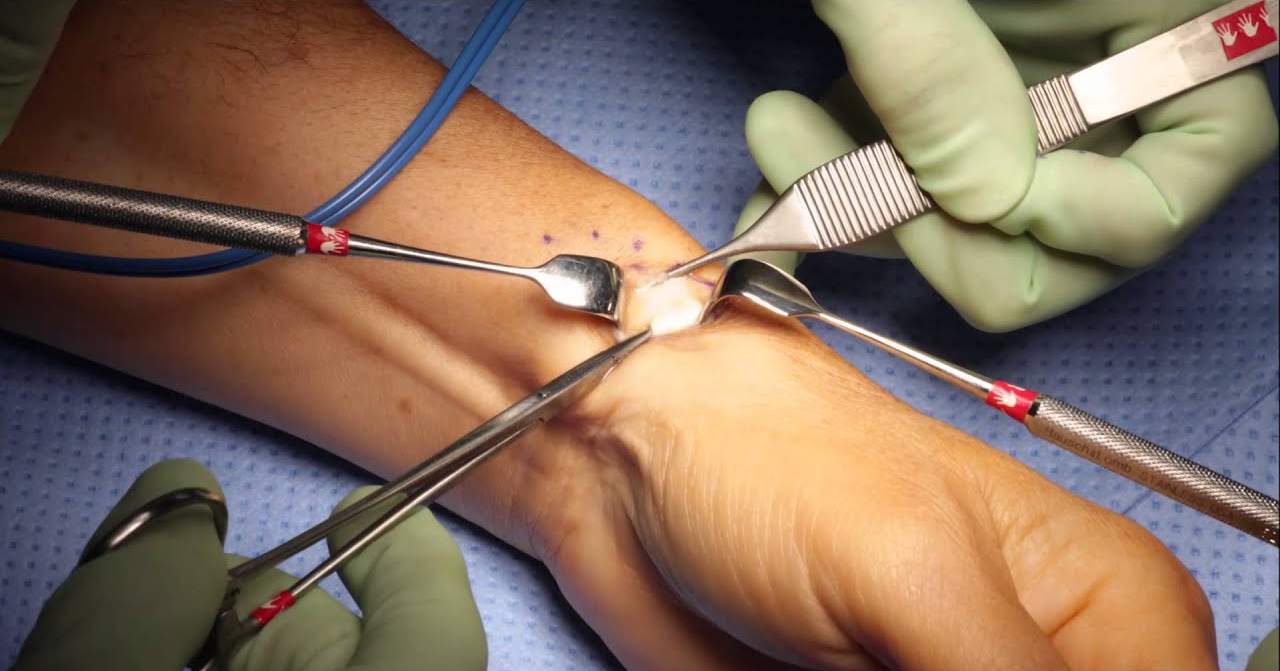
The procedure, called a de Quervain's release, is usually performed under local anesthesia as an outpatient operation. Through a small incision on the thumb side of the wrist, the surgeon carefully opens the tight tendon sheath, creating more space for the tendons to glide freely without friction.
The tendons themselves are not removed or repaired. Instead, the surgery relieves the constriction that causes pain during thumb movement.
The Goal of Surgery
Surgery creates additional room for the thumb tendons to move normally. Once the pressure is relieved, tendon irritation usually resolves over time as healing progresses.
Recovery After Surgery
Recovery varies from person to person but generally progresses steadily over several weeks. During the first few days, patients are encouraged to elevate the hand, protect the incision, and gently move the fingers to reduce stiffness.
Most people resume light daily activities within two to three weeks. More demanding work involving repetitive gripping, heavy lifting, tools, sports, or prolonged thumb use may require additional healing time.
Your surgeon may recommend hand therapy if stiffness, scar sensitivity, or weakness persists during recovery.
Typical Recovery Timeline
- First few days: Protect the incision and reduce swelling.
- 1–2 weeks: Follow-up visit and stitch removal if needed.
- 2–6 weeks: Gradually resume light daily activities.
- Several months: Strength and comfort continue improving.
How to Reduce the Risk of Symptoms Returning
Although no prevention strategy is perfect, reducing repeated strain on the thumb tendons greatly lowers the chance of another flare-up.
- Alternate hands while using your smartphone.
- Use voice dictation for long messages.
- Avoid prolonged forceful pinching.
- Keep the wrist relatively straight while lifting.
- Take frequent breaks during repetitive activities.
- Increase activity gradually after symptoms improve.
- Stop activities that reproduce sharp thumb-side wrist pain.
The Most Common Recovery Mistake
Many people return to normal gripping, lifting, sports, or childcare as soon as the pain improves. Unfortunately, the tendon sheath often hasn't fully healed. Gradually increasing activity greatly reduces the risk of another flare-up.
Summary
De Quervain's syndrome affects the tendons on the thumb side of the wrist. It commonly causes pain during thumb movement, gripping, pinching, lifting, texting, gaming, or wrist twisting.
Unlike carpal tunnel syndrome, de Quervain's syndrome usually does not cause numbness, tingling, nighttime hand symptoms, or fingers falling asleep. Those symptoms are more consistent with nerve compression.
Most cases improve without surgery when treatment begins early. Activity modification, proper thumb support, pain control, and gradual rehabilitation reduce tendon irritation and allow the tendon sheath to recover. Corticosteroid injections or surgery may be considered when symptoms remain severe or persistent.
Key Takeaways
- Thumb-side wrist pain is the primary symptom.
- Gripping, pinching, lifting, texting, and thumb movement often worsen the pain.
- Swelling, tenderness, catching, or restricted thumb movement may occur.
- Numbness and tingling suggest a different condition, such as carpal tunnel syndrome.
- Diagnosis is usually based on symptoms and a physical examination.
- Early treatment commonly includes activity modification and a thumb-spica brace.
- Steroid injections may help when conservative treatment is not enough.
- Surgery is generally reserved for persistent cases.
Return to Activity Gradually
Pain may improve before the irritated tendon sheath has fully recovered. Returning too quickly to forceful gripping, lifting, sports, gaming, childcare, or repetitive thumb use can trigger another flare.
When to Seek Medical Care
Seek medical care if the pain is severe, worsening, related to an injury, or interfering with normal hand use. An evaluation is also recommended when symptoms persist despite appropriate rest, activity modification, and thumb support.
Could Your Symptoms Be Carpal Tunnel Instead?
De Quervain's syndrome primarily causes thumb-side wrist pain. Numbness, tingling, nighttime symptoms, hand weakness, or fingers falling asleep are more typical of carpal tunnel syndrome.
About Dr. Maik Zannakis
Dr. Maik Zannakis is a soft-tissue injury specialist and Medical Director of CarpalRx. His work focuses on helping patients understand hand and wrist symptoms, distinguish tendon disorders from nerve compression, and explore appropriate nonsurgical treatment options.
Questions about your symptoms? Contact CarpalRx or read Dr. Zannakis's full professional biography.
Medical References
The following medical and scientific resources provide additional information about the causes, diagnosis, treatment, rehabilitation, and surgical management of de Quervain's syndrome.
Government & Medical Organizations
- American Academy of Orthopaedic Surgeons: De Quervain's Tendinosis
- American Society for Surgery of the Hand: de Quervain's Tenosynovitis
- Cleveland Clinic: De Quervain's Tendinosis
- Mayo Clinic: De Quervain Tenosynovitis—Diagnosis and Treatment
Peer-Reviewed Research
- Ali M, et al. Frequency of De Quervain's Tenosynovitis and Its Association With SMS Texting
- Goel R, Abzug JM. De Quervain's Tenosynovitis: A Review of the Rehabilitative Options
- Johnson JD, Gaspar MP, Shin EK. Stenosing Tenosynovitis Due to Excessive Texting in an Adolescent Girl
- Kazmers NH, et al. Deferring Routine Wrist Radiography in Patients With a Clinical Diagnosis of De Quervain's Tenosynovitis
- Rowland P, et al. The Effectiveness of Corticosteroid Injection for De Quervain's Stenosing Tenosynovitis: A Systematic Review and Meta-Analysis
- Stahl S, et al. Work-Related Etiology of De Quervain's Tenosynovitis: A Case-Control Study With Prospectively Collected Data