Current scientific evidence has not shown that
homeopathic remedies for carpal tunnel work better than placebo. While some people report feeling better, studies have not demonstrated that homeopathy reduces pressure on the median nerve or treats the underlying cause of carpal tunnel syndrome.
Many people searching for
homeopathic remedies for carpal tunnel are hoping to find a natural treatment that avoids medication, steroid injections, or surgery.
That's understandable. When numbness, tingling, and wrist pain interfere with daily life, it's tempting to try any product that promises relief.
The important question, however, isn't whether a remedy is labeled "natural." It's whether scientific evidence shows that it actually works.
Many natural products have legitimate medical uses, but every treatment should be judged by the quality of the scientific evidence supporting it.
Unfortunately, current research has not demonstrated that homeopathic remedies improve carpal tunnel syndrome beyond a placebo effect. Understanding why can help you avoid ineffective treatments and focus on therapies that are supported by medical evidence.
Do homeopathic remedies work for carpal tunnel?
Current scientific evidence has not shown that homeopathic remedies for carpal tunnel work better than placebo. Although some people report temporary improvement, homeopathy has not been shown to reduce pressure on the median nerve or treat the underlying cause of carpal tunnel syndrome.
People Also Ask
- Do homeopathic remedies work for carpal tunnel?
- What is the best natural treatment for carpal tunnel syndrome?
- Can homeopathy reduce numbness and tingling?
- Why do some people believe homeopathic medicine works?
Could Your Symptoms Really Be Carpal Tunnel?
Before trying any treatment, make sure your symptoms are actually caused by carpal tunnel syndrome and learn how advanced the condition may be.
Check Your Symptoms
Test Your Severity
What Exactly Is Homeopathy?
Homeopathy is a form of alternative medicine developed more than 200 years ago. It is based on two central ideas:
- "Like cures like," meaning a substance that causes symptoms in a healthy person is believed to treat similar symptoms in someone who is ill.
- Repeated dilution, where a substance is diluted many times with water or alcohol. Homeopathic practitioners believe this process increases the remedy's effectiveness, even when little or none of the original ingredient remains.
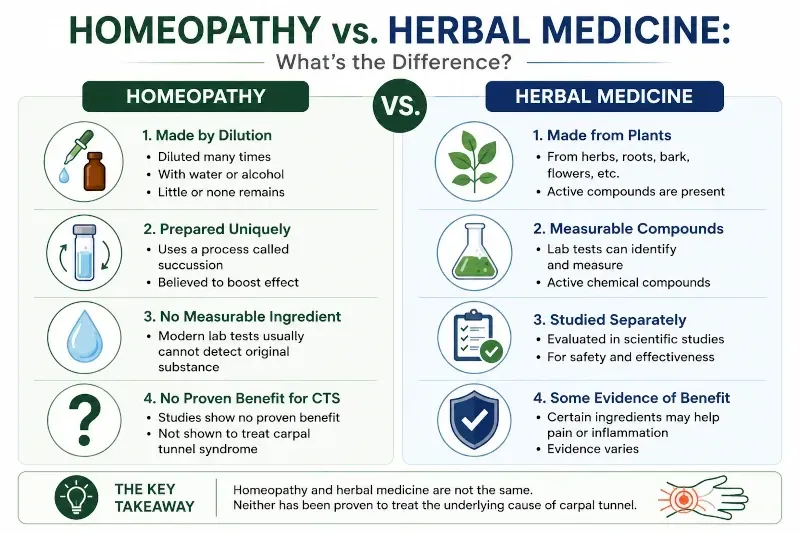
It's important not to confuse
homeopathy with
herbal medicine.
Herbal products often contain measurable amounts of plant ingredients that may have biological effects. Homeopathic remedies, on the other hand, are prepared using a unique dilution process that differs fundamentally from conventional herbal therapies.
Because of this distinction, scientific studies evaluate homeopathy separately from herbal medicine when assessing effectiveness.
Do Homeopathic Remedies Work for Carpal Tunnel?
The short answer is
no.
Despite being widely marketed for pain, inflammation, and nerve disorders,
there is currently no convincing scientific evidence that homeopathic remedies improve carpal tunnel syndrome better than a placebo.
The reason is straightforward.
Carpal tunnel syndrome develops because the median nerve becomes compressed inside the wrist. Effective treatment must reduce that pressure by decreasing tendon swelling, improving tendon movement, or surgically enlarging the carpal tunnel.
To date, homeopathic remedies have not been shown to accomplish any of these goals.
That doesn't necessarily mean people never feel better after taking them. Symptoms of carpal tunnel often fluctuate naturally from day to day.
Resting the hand, modifying activities, wearing a wrist brace, or simply allowing time to pass can all make symptoms improve. When improvement occurs after starting a homeopathic remedy, it's easy to assume the remedy deserves the credit.
Researchers describe this as
correlation
rather than
causation. Simply because two events occur together doesn't mean one caused the other.
For this reason, physicians rely on carefully controlled clinical studies rather than personal testimonials when deciding whether a treatment actually works.
Today, the best available evidence has not shown that homeopathic remedies relieve median nerve compression or alter the course of carpal tunnel syndrome.
Testimonials Are Not Scientific Evidence
People may sincerely believe a remedy helped them, but personal experiences cannot determine whether a treatment truly works. That's why researchers compare treatments with placebos in carefully controlled clinical trials.
Why Do Some People Believe They Work?
If scientific studies have not demonstrated that homeopathic remedies treat carpal tunnel syndrome, why do so many people say they helped?
There are several reasons.
One is the
placebo effect. Simply believing that a treatment will help can reduce the perception of pain and improve a person's overall sense of well-being. The brain has a remarkable ability to influence how symptoms are experienced, particularly pain.
Another reason is that carpal tunnel symptoms naturally come and go. Many people experience better days and worse days, especially in the early stages of the condition. If symptoms improve shortly after starting a homeopathic remedy, it's easy to conclude that the remedy caused the improvement—even when the change may have occurred anyway.
Many patients also begin several treatments at the same time. For example, someone may start taking a homeopathic product while also:
- wearing a
wrist brace at night
- reducing repetitive hand activities
- stretching their fingers and wrist
- taking more frequent rest breaks
When symptoms improve, it becomes impossible to know which change actually made the difference.
Finally, people naturally remember successes more vividly than failures. If a product seems to help once, that experience often leaves a stronger impression than the many times it had no noticeable effect.
Together, these factors help explain why homeopathy continues to have devoted supporters even though clinical studies have not shown it to be an effective treatment for carpal tunnel syndrome.
Feeling Better Doesn't Always Explain Why
Pain naturally fluctuates, and symptoms often improve after rest or lifestyle changes. That's why carefully controlled clinical studies are needed to determine whether a treatment truly works or whether improvement would have happened anyway.
What's Inside Homeopathic Remedies?
One of the biggest misconceptions about homeopathic remedies is that they are simply another type of herbal medicine.
They are not.
Homeopathic products often begin with plant, mineral, or animal substances. However, those starting ingredients are repeatedly diluted according to homeopathic principles. Many commercially available products are diluted to the point that little or none of the original substance can be measured using modern laboratory methods.
Homeopathic practitioners believe the repeated dilution process somehow preserves the healing properties of the original ingredient. This concept is central to homeopathic theory.
However, modern medicine has not found convincing scientific evidence that these highly diluted preparations produce biological effects capable of treating carpal tunnel syndrome.
That distinction is important because
carpal tunnel is a mechanical disorder. The median nerve becomes compressed inside the wrist, and successful treatment requires reducing that pressure. Whether through night bracing, activity modification, stretching exercises, myofascial release massage, or surgery, effective treatments work by addressing the underlying cause rather than relying on highly diluted preparations.
If homeopathic remedies haven't been shown to treat carpal tunnel syndrome, what options have stronger scientific support?
Natural Doesn't Always Mean Effective
Many products marketed as "natural" have never been shown to treat carpal tunnel syndrome. Whether a treatment is natural or synthetic is less important than whether high-quality clinical studies demonstrate that it actually works.
Homeopathy vs. Evidence-Based Treatment
| Question |
Homeopathic Remedies |
Evidence-Based CTS Treatments |
| Scientific support
|
No convincing evidence for CTS |
Supported by clinical research (varies by treatment) |
| Reduces median nerve pressure
|
Not demonstrated |
✔ Yes |
| Treats the underlying problem
|
No demonstrated evidence |
✔ Yes |
| May produce a placebo effect
|
✔ Yes |
✔ Yes (plus proven treatment effects) |
| Clinical role
|
Not shown to treat carpal tunnel syndrome |
Recommended by major medical organizations
|
Homeopathic Remedies vs. Evidence-Based CTS Treatments
Scientific Support
Homeopathy: No convincing evidence for CTS
Evidence-based: Supported by clinical research
Reduces Median Nerve Pressure
Homeopathy: Not demonstrated
Evidence-based: ✔ Yes
Treats the Underlying Problem
Homeopathy: No demonstrated evidence
Evidence-based: ✔ Yes
Placebo Effect
Homeopathy: ✔ Possible
Evidence-based: ✔ Possible (plus proven treatment effects)
Bottom Line
Evidence-based treatments have substantially stronger scientific support for treating carpal tunnel syndrome.
Better-Supported Treatments for Carpal Tunnel
If you're considering homeopathic remedies for carpal tunnel, it's worth comparing them with treatments that have considerably stronger scientific support.
Unlike homeopathic remedies for carpal tunnel, these treatments are designed to reduce pressure on the median nerve rather than simply relieve symptoms.
Common evidence-supported options include:
For patients with severe nerve compression or progressive muscle weakness, surgery may become the most appropriate treatment.
The important point is that these therapies are designed to address the underlying mechanical problem inside the wrist. That's fundamentally different from treatments that have not been shown to change the disease process itself.
Choose Treatments Backed by Evidence
Knowing how severe your carpal tunnel syndrome is can help you choose treatments supported by medical evidence rather than marketing claims.
Check Your Symptoms
Test Your Severity
Summary
Current scientific evidence has not shown that
homeopathic remedies for carpal tunnel treat the underlying cause of carpal tunnel syndrome or perform better than placebo in controlled studies.
While some people report temporary symptom improvement, those changes may be related to the placebo effect, natural symptom fluctuations, or other treatments started at the same time. Delaying effective treatment while relying on unproven remedies may also allow symptoms to progress, making recovery more difficult later.
If your goal is lasting relief, choose treatments supported by well-designed clinical research rather than marketing claims or personal testimonials.
Key Takeaways
- Homeopathy and herbal medicine are not the same.
- Scientific studies have not shown homeopathic remedies to be effective treatments for carpal tunnel syndrome.
- Temporary improvement may result from the placebo effect or the natural fluctuation of symptoms.
- Effective treatment should reduce pressure on the median nerve rather than simply relieve symptoms.
- Night bracing, stretching, activity modification, and myofascial release massage have stronger scientific support than homeopathic remedies.
- Always discuss persistent numbness, weakness, or hand pain with a qualified healthcare professional.
Selected Sources
About Dr. Zannakis