Too much sex probably does
not directly cause carpal tunnel syndrome. However, certain sexual positions that place prolonged pressure on bent wrists may increase pressure inside the carpal tunnel, potentially aggravating existing symptoms or contributing to wrist strain in susceptible individuals.
Many people wonder whether
too much sex can cause carpal tunnel syndrome. At first glance, the question may seem surprising. However, from a medical standpoint, it's actually a reasonable question because certain sexual positions can place considerable stress on the wrists.
The reason is simple: some positions require supporting a significant amount of body weight on bent wrists for prolonged periods. We already know that these same wrist positions dramatically increase pressure inside the carpal tunnel. The question is whether that additional pressure is enough to contribute to carpal tunnel syndrome.
The short answer is
probably not by itself. Current evidence does not show that sexual intercourse directly causes carpal tunnel syndrome. However, in people who already have risk factors—or who unknowingly have early carpal tunnel syndrome—certain wrist positions during sex may aggravate symptoms or make an existing problem more noticeable.
To understand why, it helps to look at what actually increases pressure inside the carpal tunnel.
Can too much sex cause carpal tunnel syndrome?
Probably not directly. However, certain sexual positions that require prolonged weight-bearing on bent wrists can substantially increase pressure inside the carpal tunnel. In people who already have early carpal tunnel syndrome or other risk factors, this added pressure may aggravate symptoms or make an existing condition more noticeable.
People Also Ask
- Can sex make carpal tunnel syndrome worse?
- Can supporting your weight on your hands cause carpal tunnel?
- Why do my wrists hurt after sex?
- What activities increase pressure inside the carpal tunnel?
Could Wrist Pain During Sex Be Carpal Tunnel Syndrome?
If certain activities—including sex—cause numbness, tingling, or hand weakness, you may already have early carpal tunnel syndrome. Our free assessment can help you understand your symptoms.
Check Your Symptoms
Test Your Severity
Can Sex Cause Carpal Tunnel Syndrome?
The answer is
probably not directly.
At present, there is
no clinical evidence showing that sexual intercourse itself causes carpal tunnel syndrome. In other words, researchers have not identified sex as an independent risk factor in the same way as diabetes, pregnancy, obesity, rheumatoid arthritis, or repetitive occupational hand use.
However, that doesn't mean sexual activity is completely unrelated.
Certain sexual positions can place
substantial mechanical stress on the wrists, particularly when one partner supports much of their upper body weight on extended (bent-back) hands. If those wrists are already susceptible to carpal tunnel syndrome, the additional pressure may temporarily increase symptoms such as numbness, tingling, pain, or hand weakness.
Think of it this way:
sexual intercourse probably doesn't create carpal tunnel syndrome, but it can expose an existing problem that has not yet been recognized.
Sex Probably Doesn't Cause CTS—But It May Reveal It
Many people first notice carpal tunnel symptoms during a specific activity such as sleeping, driving, cycling, yoga, push-ups, or sexual intercourse. The activity isn't necessarily the cause—it simply places enough stress on the wrist to uncover an existing problem.
Why Wrist Position Matters
The key issue isn't sexual intercourse itself—it's
wrist position.
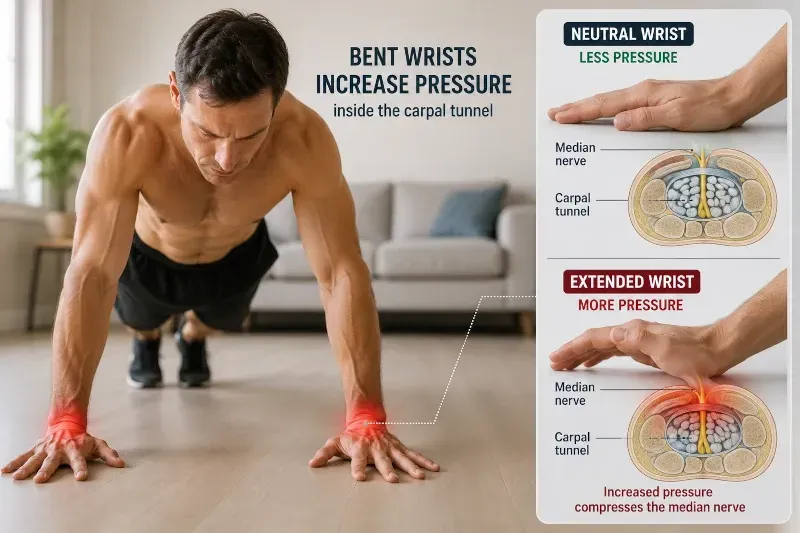
Carpal tunnel syndrome develops when pressure builds inside the narrow passageway at the wrist known as the carpal tunnel. That pressure compresses the median nerve, producing symptoms such as numbness, tingling, burning, weakness, and clumsiness.
Research has consistently shown that bending the wrist backward (extension) significantly increases pressure inside the carpal tunnel. Supporting body weight on that extended wrist raises the pressure even further.Supporting body weight on that bent wrist increases the pressure even further.
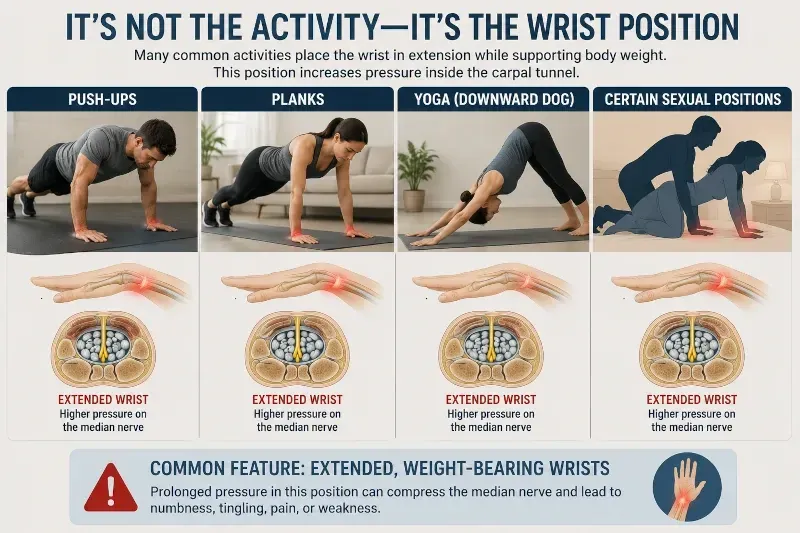
This is why activities such as push-ups, certain yoga poses, wheelbarrow pushing, crawling on the hands, and some sexual positions can all aggravate wrist symptoms in susceptible individuals.
The common denominator isn't the activity itself. It's
prolonged weight-bearing on an extended wrist.
It's About Mechanics, Not the Activity
Any activity that combines a bent wrist with prolonged pressure can increase stress inside the carpal tunnel. Sexual intercourse is simply one example—not a unique cause of carpal tunnel syndrome.
Activities That Increase Wrist Pressure
| Activity |
Typical Wrist Position |
Weight on Wrist |
Relative Wrist Stress |
| Typing |
Slight bend |
None |
Low |
| Driving |
Neutral to slight bend |
Minimal |
Low–Moderate |
| Cycling |
Extended |
Partial body weight |
Moderate |
| Push-ups |
Extended |
High |
High
|
| Planks |
Extended |
High |
High
|
| Certain Yoga Poses |
Extended |
Moderate to high |
High
|
| Certain Sexual Positions
|
Extended
|
Moderate to high
|
High
|
Activities That Increase Wrist Pressure
Typing
Wrist: Slight bend
Weight: None
Stress: Low
Driving
Wrist: Neutral to slight bend
Weight: Minimal
Stress: Low–Moderate
Cycling
Wrist: Extended
Weight: Partial body weight
Stress: Moderate
Push-ups
Wrist: Extended
Weight: High
Stress: High
Planks
Wrist: Extended
Weight: High
Stress: High
Certain Yoga Poses
Wrist: Extended
Weight: Moderate to high
Stress: High
Certain Sexual Positions
Wrist: Extended
Weight: Moderate to high
Stress: High
Think Beyond Sex
If your hands also become numb or tingle during push-ups, yoga, cycling, driving, or while sleeping, the underlying problem is much more likely to be carpal tunnel syndrome
than sexual activity itself. In most cases, sex simply places enough stress on the wrist to reveal an existing condition.
Which Sexual Positions Place the Greatest Stress on the Wrist?
Although no studies have compared specific sexual positions, the underlying biomechanics are well understood.
Positions are most likely to stress the wrists when they require one partner to:
- Support much of their upper body weight on their hands.
- Keep the wrists bent backward for prolonged periods.
- Maintain the same position without changing hand placement.
- Repeatedly push upward through the palms.
These movements resemble other activities known to aggravate carpal tunnel symptoms, including push-ups, planks, certain yoga poses, and crawling on the hands.
Conversely, positions that allow the wrists to remain relatively straight or transfer body weight to the forearms generally place much less stress on the carpal tunnel.
It's important to emphasize that
no particular sexual position has been proven to cause carpal tunnel syndrome. The concern is simply the amount of pressure placed on the wrist—not the activity itself.
Body Weight Matters
The greater the amount of body weight supported by the hands—and the longer the wrists remain bent—the greater the mechanical stress placed on the median nerve.
Who Is Most Likely to Notice Symptoms?
Most people will
never develop carpal tunnel syndrome because of sexual activity. However, certain individuals are much more likely to notice wrist pain, numbness, or tingling during or after sex because they already have factors that increase pressure on the median nerve.
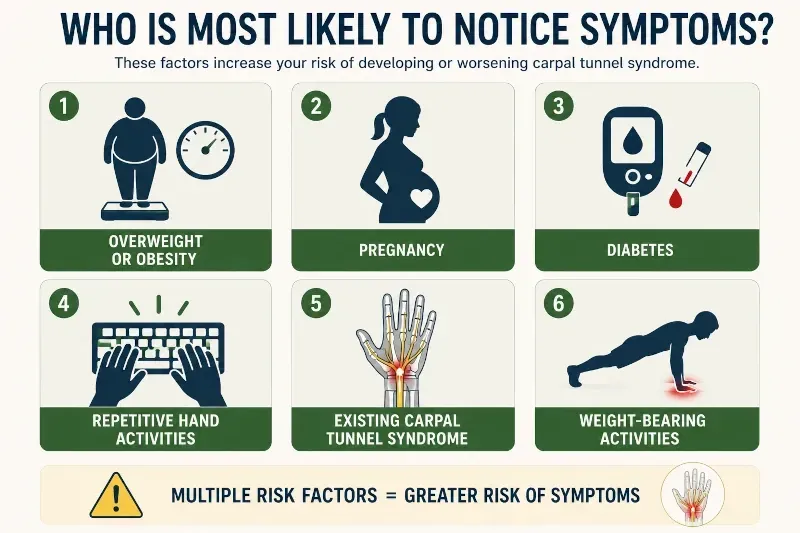
You may be more susceptible if you:
- Already have mild or undiagnosed carpal tunnel syndrome.
- Have diabetes, rheumatoid arthritis, or thyroid disease.
- Are overweight or obese, which increases overall load on the wrists.
- Are pregnant, when fluid retention naturally raises pressure inside the carpal tunnel.
- Frequently perform repetitive hand activities at work or during hobbies.
- Participate in activities that repeatedly stress the wrists, such as weightlifting, gymnastics, yoga, racquet sports, or cycling.
Sexual activity simply becomes
one more situation in which the wrist is placed under mechanical stress. If the median nerve is already vulnerable, symptoms may become noticeable for the first time.
One Activity Rarely Acts Alone
Carpal tunnel syndrome usually develops from the combined effects of many risk factors over time. Sexual activity is unlikely to be the sole cause, but it can contribute to symptoms when other risk factors are already present.
When Sex Reveals Undiagnosed Carpal Tunnel Syndrome
Many people assume that if their hands become numb during sex, the activity itself must be causing the problem.
In reality, the opposite is often true.
Sexual intercourse may simply be the
first activity demanding enough to expose an underlying carpal tunnel syndrome that has been quietly developing for months or even years.
This happens because symptoms often don't appear until pressure inside the carpal tunnel reaches a critical level. Once that threshold is crossed, everyday activities that place additional stress on the wrist can suddenly trigger numbness, tingling, pain, or weakness.
The same pattern occurs during:
- Push-ups
- Planks
- Yoga poses that support body weight on the hands
- Long bicycle rides
- Driving for extended periods
- Sleeping with bent wrists
None of these activities necessarily
cause carpal tunnel syndrome. Rather, they expose an existing condition by temporarily increasing pressure on the median nerve.
If your hands repeatedly become numb or weak during several different activities—not just during sex—it may be time to evaluate whether carpal tunnel syndrome is the underlying cause.
Don't Ignore Repeated Symptoms
If numbness, tingling, or hand weakness occurs repeatedly during sex and other everyday activities, the problem may be early carpal tunnel syndrome rather than the activity itself. Persistent symptoms deserve evaluation before nerve damage progresses.
Could Your Wrist Symptoms Be Early Carpal Tunnel Syndrome?
If certain activities consistently trigger numbness, tingling, or hand weakness, don't ignore the warning signs. Find out whether your symptoms are consistent with carpal tunnel syndrome.
Check Your Symptoms
Test Your Severity
How to Reduce Wrist Strain During Sex
If you notice wrist pain, numbness, or tingling during or after sex, there's no reason to assume you must stop being sexually active. Instead, focus on
reducing the mechanical stress placed on your wrists.
Simple adjustments can often make a noticeable difference. Recommendations include:
- Keep your wrists as straight (neutral) as possible instead of bent backward.
- Avoid supporting your full body weight on your hands for prolonged periods.
- Avoid locking your elbows,
which transfers more force directly into the wrists.
- Shift your weight to your forearms whenever practical.
- Change positions periodically rather than holding one position for a long time.
- If your wrists become numb or painful, stop and allow them to recover before continuing.
These same principles also apply to other weight-bearing activities such as push-ups, planks, certain yoga poses, gardening, and crawling on the hands.
If wrist symptoms continue to occur during several different activities—not just during sex—you should consider being evaluated for carpal tunnel syndrome or another wrist disorder.
Listen to Your Wrists
Pain, numbness, tingling, or weakness are warning signs—not something to ignore. If the same symptoms occur repeatedly during sex and other everyday activities, they may indicate an underlying wrist problem that deserves evaluation.
Summary
Current scientific evidence does
not show that sexual intercourse directly causes carpal tunnel syndrome. However, certain sexual positions can place significant stress on bent wrists, increasing pressure inside the carpal tunnel.
For people who already have early carpal tunnel syndrome or other risk factors, that extra pressure may aggravate symptoms or reveal a condition that had previously gone unnoticed.
The important point is that
wrist mechanics—not sexual activity itself—are the most likely explanation.
Any activity requiring prolonged weight-bearing on bent wrists, including push-ups, yoga, crawling, and certain sexual positions, can temporarily increase pressure on the median nerve.
If numbness, tingling, pain, or hand weakness occurs repeatedly during sex and other everyday activities, consider being evaluated for carpal tunnel syndrome rather than assuming the activity itself is the cause.
Key Takeaways
- Current evidence does not support sexual intercourse as a direct cause of carpal tunnel syndrome.
- The greatest concern is prolonged weight-bearing on bent wrists, not sexual activity itself.
- Existing carpal tunnel syndrome may first become noticeable during sex because of increased wrist pressure.
- The same wrist mechanics occur during push-ups, yoga, cycling, and other weight-bearing activities.
- Keeping the wrists in a more neutral position may reduce mechanical stress.
- Persistent numbness, tingling, pain, or hand weakness during multiple activities should prompt evaluation for carpal tunnel syndrome.
- If symptoms occur during several different activities, carpal tunnel syndrome is far more likely than sex itself to be the underlying cause.
Selected Sources
About Dr. Zannakis