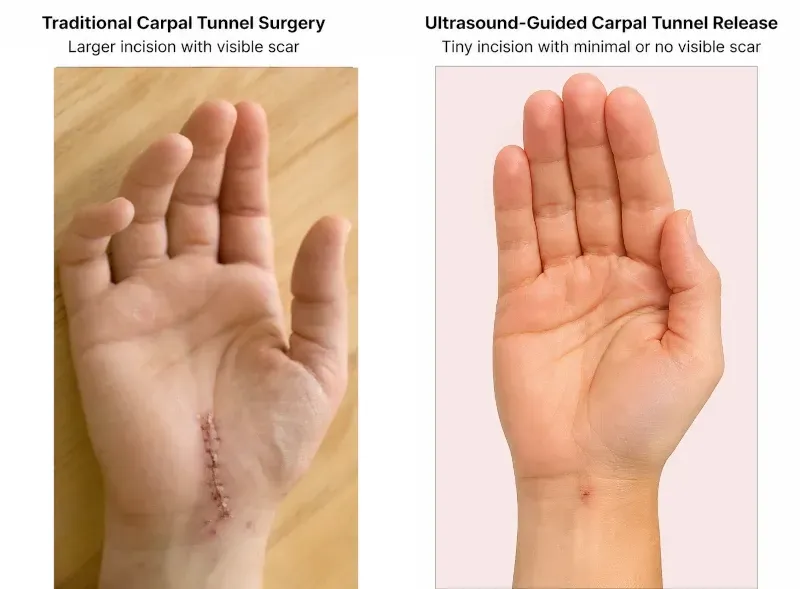
Ultrasound guided carpal tunnel release is a newer minimally invasive surgery that may reduce pain, scarring, and recovery time compared to traditional open carpal tunnel surgery.
Carpal tunnel syndrome can cause numbness, tingling, pain, and hand weakness that interfere with sleep, work, and daily activities. When braces, therapy, or injections stop helping, surgery is often recommended.
A newer technique called
ultrasound guided carpal tunnel release is now being studied as a less invasive alternative to traditional open surgery. Instead of a large palm incision with stitches, surgeons use ultrasound imaging and a tiny incision to release pressure on the median nerve. Early research suggests patients may experience less pain, minimal scarring, and faster recovery.
Ultrasound guided carpal tunnel release
is a minimally invasive procedure that uses real-time ultrasound imaging and a tiny incision to release pressure on the median nerve. Compared to traditional open surgery, it may result in less pain, faster recovery, and almost no visible scar.
Find Out If Your Symptoms Are Really Carpal Tunnel
Many hand problems mimic carpal tunnel syndrome. Take our free symptom self-test and severity quiz to better understand what may be causing your numbness, tingling, pain, or weakness.
People Also Ask
What is ultrasound guided carpal tunnel release?
Ultrasound guided carpal tunnel release is a minimally invasive procedure that uses real-time ultrasound imaging and a tiny incision to relieve pressure on the median nerve inside the wrist.
Is ultrasound guided carpal tunnel surgery better than open surgery?
Early studies suggest it may reduce pain, scarring, and recovery time compared to traditional open surgery, but more long-term research is still needed.
Does ultrasound guided carpal tunnel release leave a scar?
The procedure uses a very small incision, so scarring is usually minimal and often barely visible.
Can carpal tunnel surgery be done without stitches?
Some minimally invasive ultrasound guided procedures use such a small incision that stitches may not be necessary.
How long does recovery take after minimally invasive carpal tunnel surgery?
Recovery varies, but many patients may return to normal activities faster than with traditional open surgery because the incision is much smaller.
What Is Ultrasound Guided Carpal Tunnel Release?
Ultrasound guided carpal tunnel release is a newer minimally invasive procedure that relieves pressure on the median nerve through a very small incision instead of the larger palm incision used in traditional
open release surgery.
Using real-time
ultrasound imaging, surgeons can see the nerve, tendons, blood vessels, and ligament during the procedure. A specialized blade is inserted through the tiny incision to cut the
transverse carpal ligament and open the carpal tunnel.
Potential advantages include:
Why Traditional Carpal Tunnel Surgery Has Drawbacks
Traditional open carpal tunnel surgery is effective, but it requires a larger incision in the palm that is closed with stitches. Because the palm is heavily used for gripping and lifting, recovery can sometimes be uncomfortable.
Common drawbacks may include:
These limitations have led surgeons to explore less invasive alternatives that may shorten recovery and reduce scar pain.
How Ultrasound Helps Surgeons
Ultrasound allows surgeons to view delicate wrist structures in real time during surgery, including:
- The median nerve
- Tendons
- Blood vessels
- The transverse carpal ligament
Instead of creating a large opening to directly expose the area, surgeons can guide instruments through a tiny incision while watching the procedure on an ultrasound screen.
This may improve precision while reducing tissue disruption, pain, and scarring.
The difference in incision size and visible scarring may be one of the biggest advantages of ultrasound guided surgery.
The New Study at Sheba Medical Center
Researchers like
Dr. Mattan Biran at Sheba Medical Center in Israel are comparing traditional open surgery with ultrasound guided carpal tunnel release to determine whether the newer technique can improve recovery while maintaining safety and effectiveness.
The study is evaluating:
- Pain levels
- Hand function
- Recovery speed
- Return to work
- Patient satisfaction
- Safety outcomes
Patients are followed for six months after surgery using questionnaires and ultrasound evaluations.
Could Ultrasound Guided Carpal Tunnel Release Become the New Standard?
Ultrasound guided carpal tunnel release may eventually become a popular alternative to traditional open surgery because it offers the possibility of less pain, smaller scars, and faster recovery.
However, larger long-term studies are still needed before it can fully replace traditional surgery as the standard treatment for carpal tunnel syndrome.
As ultrasound technology continues improving and more surgeons gain experience with the technique, minimally invasive carpal tunnel surgery may become increasingly common.
Not Ready for Surgery Yet?
Many people with mild or moderate carpal tunnel symptoms improve with conservative treatment before surgery becomes necessary.
Learn How CarpalRx Therapy Works
Summary
Ultrasound guided carpal tunnel release is a newer minimally invasive technique designed to treat carpal tunnel syndrome through a tiny incision instead of the larger palm incision used in traditional open surgery. By using real-time ultrasound imaging, surgeons can precisely release pressure on the median nerve while potentially reducing pain, scarring, and recovery time. Early research from Sheba Medical Center suggests the procedure may offer outcomes comparable to standard surgery with a faster and more comfortable recovery experience.
Key Takeaways
- Ultrasound guided carpal tunnel release uses a very small incision and real-time ultrasound imaging.
- The procedure may reduce postoperative pain, scarring, and recovery time compared to open surgery.
- Traditional carpal tunnel surgery is effective but can involve scar tenderness and longer healing.
- Ultrasound helps surgeons see nerves, tendons, blood vessels, and ligaments during the procedure.
- A new study at Sheba Medical Center is comparing the newer technique with traditional open surgery.
- Researchers hope the newer method could eventually become a future standard for carpal tunnel surgery.
Frequently Asked Questions
Is ultrasound guided carpal tunnel surgery widely available?
The procedure is still newer than traditional open surgery and may only be offered by surgeons specially trained in ultrasound-guided hand procedures.
Who may qualify for minimally invasive carpal tunnel surgery?
Patients with confirmed carpal tunnel syndrome who have not improved with conservative treatment may be candidates, depending on the surgeon’s evaluation and experience.
About Dr. Zannakis