

Carpal Tunnel Compression Gloves: Do They Really Work?
From Dr. Z - Carpal tunnel syndrome specialist
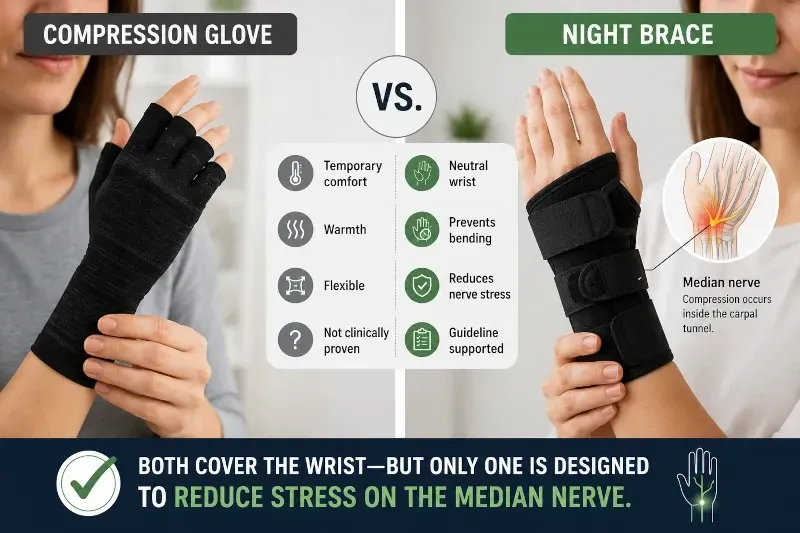
There is no convincing clinical evidence that compression gloves treat carpal tunnel syndrome or reduce pressure on the median nerve. They may provide warmth or temporary comfort, but they do not correct the underlying nerve compression inside the wrist.
Tight gloves may also increase external pressure, restrict comfortable wrist movement, or aggravate numbness and tingling. Copper-infused gloves offer no proven additional benefit.
Compression gloves are widely marketed for carpal tunnel syndrome, but current medical evidence does not support those claims. Although they may provide warmth or temporary comfort, they have not been shown to reduce median nerve compression.
This article explains what compression gloves actually do, why they may worsen symptoms in some people, what the evidence says about copper-infused gloves, and which treatments are better supported by clinical research.
Compression gloves have not been proven to treat carpal tunnel syndrome. They may provide warmth or temporary support, but they do not reduce median nerve compression and may worsen symptoms if they fit too tightly around the wrist.
- What Are Carpal Tunnel Compression Gloves?
- Do Compression Gloves Work for Carpal Tunnel?
- Why Compression Gloves May Worsen Symptoms
- Why Some People Report Temporary Relief
- Compression Gloves vs. Carpal Tunnel Braces
- What About Copper Compression Gloves?
- Can Loose Thermal Gloves Help?
- When Should You Stop Using Compression Gloves?
- What Actually Helps Carpal Tunnel?
- Summary
- About Dr. Zannakis
- Medical References
Are compression gloves good for carpal tunnel?
There is no strong clinical evidence that compression gloves improve carpal tunnel syndrome. They may provide warmth or temporary comfort, but they do not relieve the underlying median nerve compression.
Can compression gloves make carpal tunnel worse?
A tight glove may increase pressure around the wrist or aggravate numbness, tingling, burning, and pain. Stop wearing it if symptoms become worse.
Do copper gloves help carpal tunnel?
Copper-infused gloves have not been shown to reduce median nerve compression or improve carpal tunnel syndrome. Copper in the fabric has no established therapeutic effect on nerves or inflammation.
What should I wear for carpal tunnel at night?
A properly fitted night brace that keeps the wrist near neutral is generally more appropriate than a compression glove. It should not squeeze the wrist or press firmly into the palm.
Why do compression gloves sometimes feel helpful?
Temporary relief may come from warmth, mild support, reduced activity, altered hand position, or placebo effects. That does not prove the glove is reducing nerve compression.
Are compression gloves useful for arthritis?
Some people with rheumatoid arthritis report less stiffness or improved warmth while wearing therapy gloves. Those possible benefits do not establish that the same gloves treat carpal tunnel syndrome.
Numbness, tingling, burning, nighttime pain, or hand weakness may indicate median nerve compression.
- Compression gloves may provide warmth or temporary comfort.
- No high-quality evidence shows that they reduce median nerve compression.
- Copper-infused fabric has no proven therapeutic benefit.
- A tight wrist cuff may aggravate numbness, tingling, or pain.
- Temporary relief should not be mistaken for nerve recovery.
What Are Carpal Tunnel Compression Gloves?
Carpal tunnel compression gloves are close-fitting fabric gloves marketed to reduce hand pain, numbness, stiffness, and swelling. Most extend across the wrist and apply gentle pressure to the hand, fingers, and lower forearm.
Some are sold as arthritis gloves, while others are specifically labeled for carpal tunnel syndrome. Common versions include:
- Standard elastic compression gloves
- Copper-infused compression gloves
- Fingerless therapy gloves
- Thermal or warming gloves
- Gloves with built-in wrist straps or light support
These products may make the hands feel warmer or more supported. However, warmth and external compression do not address the underlying problem in carpal tunnel syndrome: pressure on the median nerve as it passes through the wrist.
Compression gloves should also not be confused with a properly fitted carpal tunnel wrist brace. A brace is designed to limit harmful wrist bending, while a compression glove mainly squeezes the surrounding tissues.
Terms such as “therapeutic compression,” “circulation support,” and “copper recovery technology” may sound medical, but they do not prove that a glove reduces median nerve pressure or treats carpal tunnel syndrome.
Do Compression Gloves Work for Carpal Tunnel?
The short answer is no—not as a treatment for carpal tunnel syndrome. While some people report feeling better while wearing compression gloves, there is no convincing clinical evidence that they reduce pressure on the median nerve or improve the condition itself.
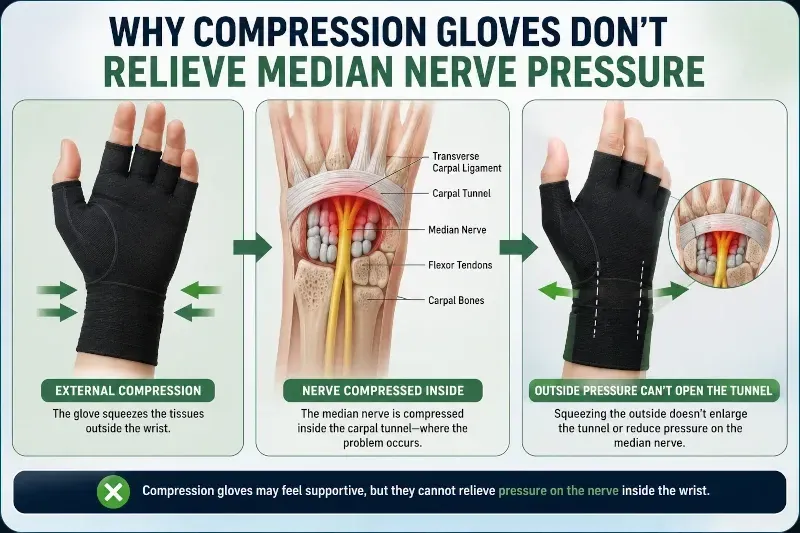
Carpal tunnel syndrome develops when the median nerve becomes compressed inside the narrow carpal tunnel at the wrist. A glove worn outside the wrist cannot enlarge that tunnel or relieve the internal pressure on the nerve.
Some manufacturers suggest that gentle compression improves circulation or reduces inflammation. Although mild compression may help certain conditions involving swelling, there is little evidence that it changes the underlying mechanics of carpal tunnel syndrome.
This does not mean every wearer feels no benefit. Warmth, light support, and simply resting the hands while wearing the gloves may temporarily lessen discomfort. However, temporary symptom relief is different from treating the cause of the problem.
Many products can temporarily make an irritated hand feel better. An effective carpal tunnel treatment, however, should reduce pressure on the median nerve—not simply make the hand feel more comfortable for a short time.
Do Compression Gloves Work for Carpal Tunnel?
Current evidence does not show that compression gloves treat carpal tunnel syndrome. They have not been proven to reduce pressure inside the carpal tunnel, improve median nerve function, or prevent symptoms from progressing.
Some users report temporary warmth, support, or comfort. Those effects may be real, but they do not prove that the underlying nerve compression is improving.
Carpal tunnel symptoms also fluctuate naturally. Feeling better for a few hours or days should not be mistaken for healing.
A glove may make the hand feel warmer or more supported without reducing pressure on the median nerve.
Why Compression Gloves May Worsen Symptoms
Carpal tunnel syndrome develops when pressure rises around the median nerve inside the wrist. Because the tunnel has very little extra space, swelling or prolonged wrist bending can interfere with the nerve's blood supply and electrical signals.
A tight glove applies additional pressure from the outside. It cannot enlarge the carpal tunnel, and a restrictive wrist cuff may aggravate numbness, tingling, burning, or pain.
Compression gloves also do not reliably keep the wrist neutral. Most remain flexible, allowing the wrist to bend sharply during sleep or activity.
Remove the glove if it causes colder fingers, deeper pressure marks, stronger numbness, more tingling, discoloration, or weakness.
Why Some People Report Temporary Relief
Temporary relief may come from warmth, reduced activity, mild support, altered hand positioning, or placebo effects. None of these possibilities means the improvement is imaginary.
The important question is whether the glove improves nerve function, restores sensation, prevents weakness, or changes the course of the condition. Current research has not demonstrated those benefits.
Compression Gloves vs. Carpal Tunnel Braces
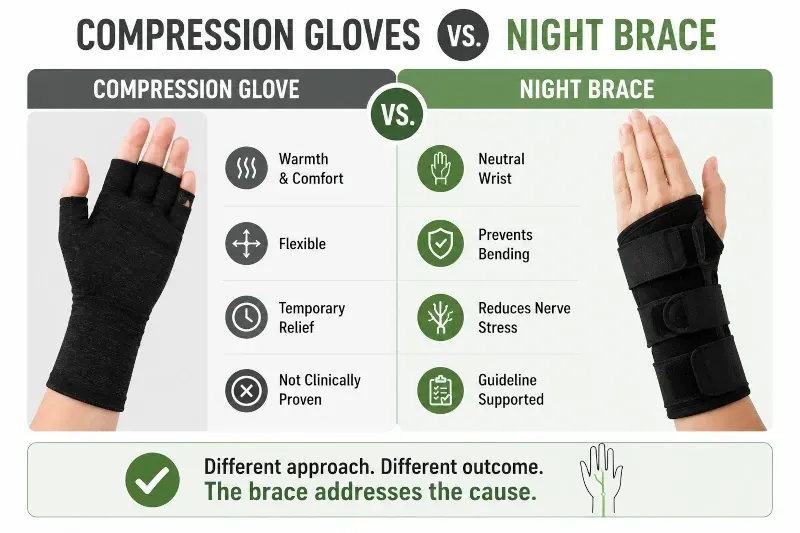
Compression gloves squeeze the hand and wrist. A properly designed night brace has a different goal: keeping the wrist near neutral without pressing into the carpal tunnel.
- Apply pressure around the hand and wrist
- Do not reliably control wrist position
- May provide warmth or brief comfort
- Not proven to reduce median nerve compression
- May worsen symptoms if too tight
- Keeps the wrist near neutral
- Reduces harmful nighttime bending
- Usually worn during sleep
- Supported by clinical guidelines
- Should not press firmly into the palm
Not every brace is appropriate. A rigid palm-side stay can create concentrated pressure if it ends near the wrist crease or pushes into the carpal tunnel.
Learn how to choose a properly fitted carpal tunnel wrist brace that supports the wrist without constricting it.
Stop using a brace if it causes stronger morning numbness, cold fingers, pressure marks, or pain directly over the wrist.
What About Copper Compression Gloves?
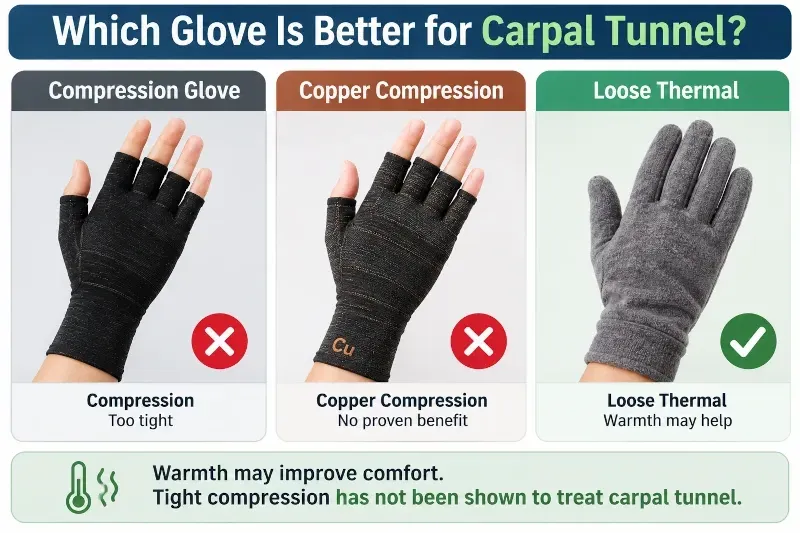
Copper-infused gloves are heavily marketed for arthritis, muscle pain, circulation problems, and carpal tunnel syndrome. Despite those claims, there is no convincing scientific evidence that copper embedded in fabric improves nerve function, reduces inflammation, or relieves median nerve compression.
If a copper glove feels helpful, the benefit almost certainly comes from the glove itself—warmth, light support, or comfort—not from the copper fibers.
Current research has not shown that copper-infused fabric treats carpal tunnel syndrome or improves recovery from median nerve compression.
What About Copper Fit® and Similar Brands?
Many manufacturers advertise compression gloves using terms such as doctor recommended , therapeutic , or designed for carpal tunnel. These statements should not be confused with proof that the gloves improve carpal tunnel syndrome.
When evaluating any glove, look for published clinical evidence rather than advertising language. At present, no major brand has produced high-quality clinical studies showing that compression gloves reverse or successfully treat carpal tunnel syndrome.
Can Loose Thermal Gloves Help?
Unlike compression gloves, loose thermal gloves do not squeeze the wrist. Their primary benefit is warmth, which many people find soothing during cold weather or while resting.
Warmth may temporarily reduce stiffness and improve comfort, but thermal gloves should also be viewed as supportive care rather than treatment. They do not relieve pressure on the median nerve.
If gloves make your hands feel better, choose loose, comfortable thermal gloves rather than tight compression gloves that may increase pressure around the wrist.
When Should You Stop Using Compression Gloves?
Stop wearing compression gloves if you notice:
- More numbness or tingling
- Increased nighttime pain
- Cold or discolored fingers
- Pressure marks around the wrist
- Reduced grip strength
- Progressively worsening symptoms
Persistent symptoms deserve proper evaluation rather than trying increasingly tighter gloves or more expensive "therapeutic" versions.
If a product consistently makes your symptoms worse, discontinue it. Effective treatment should improve function over time, not simply promise relief on the package.
What Actually Helps Carpal Tunnel?
The goal of treatment is to reduce pressure on the median nerve before permanent nerve damage develops. While no single therapy works for everyone, several nonsurgical treatments are supported by clinical guidelines and should generally be tried before surgery in appropriate patients.
- Wear a properly designed night wrist brace that keeps the wrist near neutral.
- Perform regular median nerve and tendon stretching exercises.
- Use myofascial release massage to improve soft-tissue mobility.
- Reduce prolonged gripping, forceful pinching, and repetitive wrist bending whenever possible.
- Seek medical evaluation if weakness, constant numbness, or muscle wasting develops.
The best-supported nonsurgical treatments reduce stress on the median nerve rather than increasing compression around it.
Early diagnosis gives you the best chance of avoiding permanent nerve damage and unnecessary surgery.
Summary
Compression gloves are widely marketed for carpal tunnel syndrome, but current scientific evidence does not support their use for treating median nerve compression. While some people experience temporary comfort from warmth or light support, these effects should not be mistaken for treatment.
If your symptoms include numbness, tingling, nighttime pain, or hand weakness, focus on therapies supported by clinical evidence rather than product claims. Early treatment offers the best opportunity to relieve symptoms, preserve nerve function, and avoid permanent damage.
Compression gloves have not been proven to treat carpal tunnel syndrome. Choose treatments that reduce stress on the median nerve instead of adding pressure around the wrist.
About Dr. Zannakis
Dr. Maik Zannakis is Medical Director of CarpalRx and a soft-tissue injury specialist who has spent decades studying nonsurgical treatment for carpal tunnel syndrome. He has authored more than 120 medical articles focused on peripheral nerve disorders, biomechanics, and conservative hand therapy.
Medical References
Government & Medical Organizations
- American Academy of Orthopaedic Surgeons: Carpal Tunnel Syndrome Clinical Practice Guideline
- American Society for Surgery of the Hand: Carpal Tunnel Syndrome
- U.S. Food and Drug Administration: Health Fraud Scams
- Mayo Clinic: Carpal Tunnel Syndrome—Symptoms and Causes
- National Institute of Neurological Disorders and Stroke: Carpal Tunnel Syndrome Fact Sheet
Peer-Reviewed Research & Clinical Guidelines
- American Academy of Orthopaedic Surgeons and American Society for Surgery of the Hand: Clinical Practice Guideline on Carpal Tunnel Syndrome
- Journal of Orthopaedic & Sports Physical Therapy: Hand Pain and Sensory Deficits—Carpal Tunnel Syndrome
- Journal of Orthopaedic & Sports Physical Therapy: Conservative Interventions for Carpal Tunnel Syndrome
- PubMed: Surgical Versus Nonsurgical Treatment Outcomes for Carpal Tunnel Syndrome
Patient Education & Supporting Information
- Harvard Health Publishing: The Power of the Placebo Effect
- Healthline: Compression Socks and Stockings—Benefits, Types and Side Effects
- The Wired Runner: What Are Compression Shorts and Do They Actually Work?