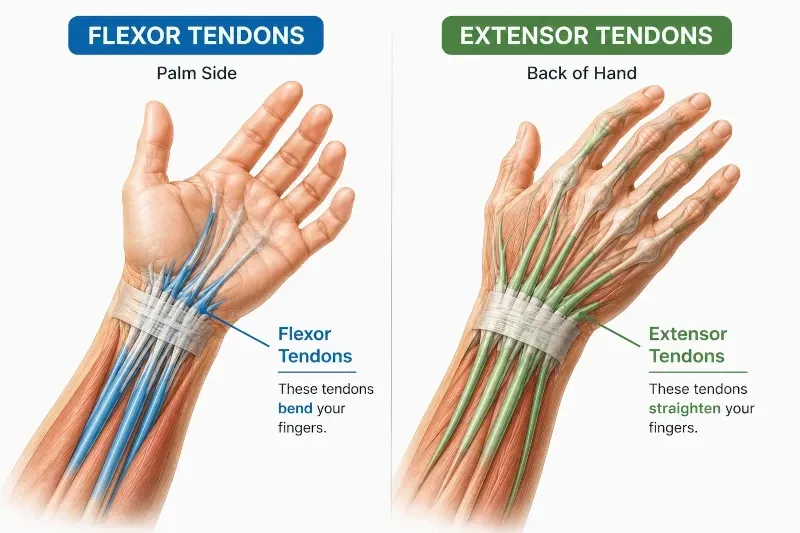
Wrist tendonitis is an overuse injury affecting the flexor or extensor tendons that move your hand and fingers. Most cases improve with rest, activity modification, stretching exercises, night splinting, and myofascial release massage.
Wrist tendonitis is one of the most common causes of wrist, hand, and lower forearm pain. Fortunately, unlike many chronic wrist disorders, it usually responds well to conservative treatment when recognized early.
The key is reducing repetitive stress while allowing the injured tendons to heal. Most patients improve without surgery by combining rest, stretching exercises, night splinting, and other simple treatments.
How is wrist tendonitis treated?
Most cases of wrist tendonitis improve with activity modification, rest, stretching exercises, night splinting, and myofascial release massage. Mild cases often recover within several weeks, while more severe tendon injuries may require six weeks or longer. The earlier treatment begins, the easier wrist tendonitis is usually to reverse and the less likely symptoms are to become chronic.
People Also Ask
- What causes wrist tendonitis?
- How do I know if I have wrist tendonitis?
- Can wrist tendonitis heal without surgery?
- How long does wrist tendonitis take to heal?
Wrist Pain That Won't Go Away?
Wrist tendonitis and carpal tunnel syndrome often cause similar symptoms. Find out which condition is more likely affecting your hand.
Check Your Symptoms
Test Your Severity
What Is Wrist Tendonitis?
Wrist tendonitis is an overuse injury affecting the tendons that connect your forearm muscles to your fingers and thumb. Repetitive gripping, lifting, typing, gaming, sports, and other hand-intensive activities can irritate these tendons over time.
As irritation continues, tiny areas of tendon damage develop. The body responds with
inflammation, swelling, and pain. Without treatment, the tendons become less flexible and everyday activities such as gripping, twisting, or lifting may become increasingly uncomfortable.
Unlike
carpal tunnel syndrome, wrist tendonitis is primarily a disorder of the tendons rather than compression of the median nerve. That distinction is important because the diagnosis, treatment, and long-term outlook are different.
Flexor vs. Extensor Wrist Tendonitis
The wrist contains two major groups of tendons. Knowing which group is irritated helps explain where your pain occurs and what movements make it worse.
Flexor tendonitis affects the tendons on the
palm side of the wrist and forearm. These tendons bend your fingers and thumb, making gripping activities painful.
Extensor tendonitis affects the tendons on the
back (knuckle side) of the wrist. These tendons straighten your fingers and stabilize your wrist during lifting and reaching.
Although both conditions are treated similarly, identifying the location of your pain can help determine which tendons are involved.
| Feature |
Flexor Tendonitis |
Extensor Tendonitis |
| Pain location
|
Palm side of wrist |
Back of wrist |
| Pain increases with
|
Gripping, lifting, typing |
Lifting, pushing, wrist extension |
| Common causes
|
Grasping, tools, gaming |
Sports, mouse use, lifting |
| Typical tenderness
|
Along flexor tendons |
Along extensor tendons |
Flexor Tendonitis
• Palm side pain
• Worse with gripping
• Common in typing & lifting
• Tender flexor tendons
Extensor Tendonitis
• Back of wrist pain
• Worse with lifting
• Common in sports & mouse use
• Tender extensor tendons
Where Does It Hurt?
Pain on the palm side of the wrist usually points toward flexor tendonitis. Pain on the back of the wrist is more commonly associated with extensor tendonitis.
Symptoms Of Wrist Tendonitis
Symptoms usually develop gradually rather than suddenly. Symptoms usually begin gradually. At first, discomfort may appear only during activity, but as tendon irritation progresses, pain can linger long after the activity ends.
Common symptoms include:
- aching wrist and forearm pain
- tenderness over the tendons
- pain with gripping or lifting
- stiffness after resting
- mild swelling
- weakness when grasping objects
- soreness extending into the forearm
Unlike carpal tunnel syndrome, wrist tendonitis usually
does not produce persistent numbness, tingling, or nighttime symptoms.
If pain, numbness, or tingling become your dominant symptoms, carpal tunnel syndrome becomes more likely than tendonitis.
How Wrist Tendonitis Is Treated
Most cases of wrist tendonitis respond well to conservative wrist tendonitis treatment and improve without surgery.
The goal of treatment is to reduce inflammation, allow the tendons to heal, and prevent the repetitive movements that caused the injury in the first place.
The most effective approach combines several conservative treatments rather than relying on just one. Depending on symptom severity, you may need only one treatment or several working together.
Rest & Activity Modification
The cornerstone of wrist tendonitis treatment is giving the irritated tendons time to recover. Rest does not mean avoiding all hand movement. Instead, temporarily reduce activities that repeatedly stress the tendons, including:
- gripping tools
- heavy lifting
- typing for long periods
- gaming
- forceful pinching
- repetitive twisting
Many mild cases begin improving within one to two weeks simply by reducing these repetitive stresses.
Pain Medicines
Over-the-counter pain relievers can temporarily reduce discomfort while your tendons heal. Common choices include:
- ibuprofen (Advil)
- naproxen (Aleve)
- aspirin
- acetaminophen (Tylenol)
These medications should be used only as directed and for short periods. They work best as part of a comprehensive treatment plan rather than as a standalone solution.
Splinting
Many healthcare providers recommend using a wrist splint during
activities that place excessive stress on the wrist. A splint
may also be worn at night if sleeping positions aggravate symptoms.
Unlike
carpal tunnel syndrome (where only nocturnal splinting is recommended), daytime splinting is usually necessary when you anticipate heavy wrist activity.
Stretching Exercises
Gentle stretching helps restore normal tendon movement and improve flexibility. Performed several times throughout the day, stretching exercises can:
- improve tendon mobility
- reduce stiffness
- break up small tendon adhesions
- increase circulation
- reduce pain during movement
Stretch only to the point of mild tension—not pain. Overstretching an inflamed tendon can delay recovery. Several short stretching sessions each day are generally more beneficial than one long session.
Myofascial Release Massage
Myofascial release massage is one of the most effective conservative treatments for moderate to severe wrist tendonitis. Unlike a traditional relaxation massage, it uses firm, targeted pressure to improve tendon mobility and reduce restrictions within the surrounding soft tissues.
As tendons become irritated, tiny adhesions can develop between tendon fibers and the surrounding fascia. These adhesions increase friction every time the tendons move, contributing to pain, stiffness, and inflammation. Myofascial release massage helps loosen these adhesions so the tendons can glide more freely during everyday activities.
Additional benefits include:
- improving blood circulation
- reducing tendon stiffness
- increasing flexibility
- decreasing pain during movement
- promoting tissue healing
Many patients perform the massage themselves using the thumb of the opposite hand, while others prefer having a partner perform the technique for deeper, more consistent pressure.
For best results, combine myofascial release massage with activity modification, stretching exercises, and splinting rather than using massage alone.
For step-by-step instructions, see our
guide. Although it focuses on carpal tunnel syndrome, the same massage principles are used to treat wrist tendonitis because both conditions benefit from improving tendon mobility and reducing soft-tissue adhesions.
Treat The Cause—Not Just The Pain
Pain medicines may temporarily reduce discomfort, but lasting improvement comes from reducing repetitive stress while allowing the injured tendons to heal.
Recovery Timeline
The time required for wrist tendonitis to heal depends on several factors, including the severity of the injury, how long symptoms have been present, and how consistently you follow your treatment plan.
As a general guide:
Mild wrist tendonitis
- Improvement often begins within 1-2 weeks.
- Most patients recover within 2 weeks.
Moderate wrist tendonitis
- Symptoms typically improve over 2-4 weeks.
- Recovery usually requires combining several treatments rather than relying on rest alone.
Severe wrist tendonitis
- Recovery may require 4-6 weeks or longer.
- More intensive treatment, including myofascial release massage and consistent stretching, is often necessary.
The earlier treatment begins, the easier recovery tends to be. Waiting until pain becomes constant or severe usually prolongs healing.
Most patients notice steady improvement rather than sudden relief. Small improvements each week generally indicate that the tendons are healing properly.
Returning to repetitive activities too soon is one of the most common reasons symptoms recur.
When To See A Doctor
Although wrist tendonitis usually improves with conservative treatment, some situations require professional evaluation.
Contact your healthcare provider if:
- pain is severe or rapidly worsening
- pain interferes with sleep despite treatment
- symptoms continue longer than several weeks despite treatment
- you cannot grip or lift everyday objects
- swelling becomes significant
- redness or warmth develops around the wrist
- you develop fever or chills
- pain follows a major injury or fall
- numbness or pain becomes persistent
Persistent numbness, nighttime symptoms, or weakness affecting the thumb and first three fingers may suggest
carpal tunnel syndrome rather than wrist tendonitis. These symptoms deserve further evaluation because treatment may differ.
Still Not Sure It's Wrist Tendonitis?
Wrist tendonitis and carpal tunnel syndrome often share similar symptoms. Use our free tools to help determine which condition is more likely affecting your hand.
Check Your Symptoms
Test Your Severity
Summary
Wrist tendonitis is an overuse injury affecting the flexor or extensor tendons that move your fingers and wrist. Fortunately, it usually responds well to conservative treatment when recognized early.
Most patients improve by combining:
- activity modification
- short-term rest
- stretching exercises
- night splinting
- myofascial release massage
Recovery depends largely on how early treatment begins, the severity of tendon injury, and how consistently you follow your treatment program. While mild cases often resolve within a few weeks, more severe tendon injuries require additional time and a more comprehensive treatment program.
Key Takeaways
- Wrist tendonitis is usually caused by repetitive overuse of the flexor or extensor tendons.
- Flexor tendonitis causes pain on the palm side of the wrist, while extensor tendonitis affects the back of the wrist.
- Most cases improve without surgery.
- Activity modification is often the most important part of treatment.
- Stretching exercises help restore tendon mobility and reduce stiffness.
- Night splinting can reduce stress on irritated tendons while you sleep.
- Myofascial release massage may speed recovery in moderate and severe cases.
- Early treatment usually leads to faster recovery and better long-term results.
About Dr. Zannakis