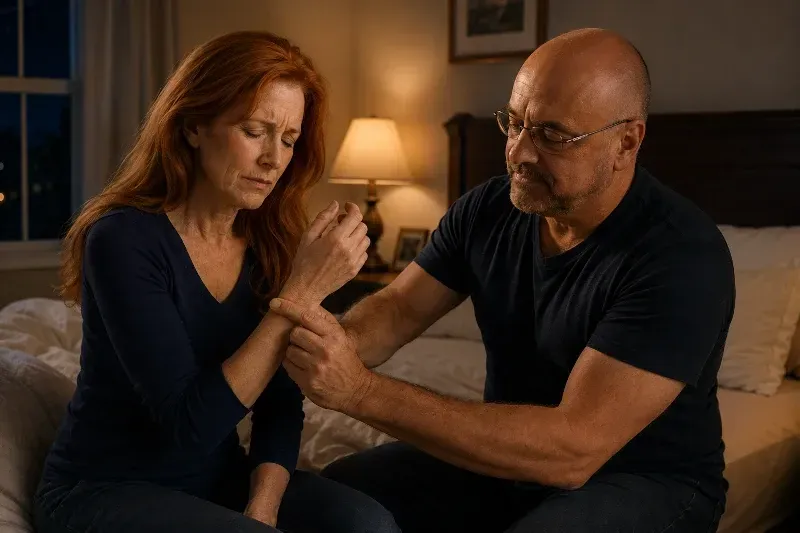
The story of the CarpalRx began when Dr. Maik Zannakis built the first prototype to relieve his wife’s severe nighttime carpal tunnel pain.
What started as a personal effort to help someone he loved eventually became a patented home therapy device used by thousands of patients.
Most medical devices begin with a business plan. The CarpalRx began with a sleepless night.
More than 20 years ago, my wife woke from a deep sleep crying because of severe hand pain. At the time, I wasn't trying to invent a product, launch a company, or create a new treatment. I simply wanted to help the person I loved.
That painful night eventually led to the first CarpalRx prototype, years of engineering, multiple clinical studies, and a therapy that has helped thousands of people with carpal tunnel syndrome.
This is the story of the CarpalRx—and how one unexpected moment changed my professional life forever.
How was the CarpalRx invented?
The CarpalRx was invented by Dr. Maik Zannakis after his wife developed severe nighttime carpal tunnel syndrome. While performing myofascial release massage on her wrist, he realized that the kneading movements of his hands could be reproduced mechanically. He built the first prototype the very next day, eventually refining it through years of engineering improvements, clinical research, and patient feedback.
What follows is the complete story
—from one sleepless night in our bedroom to multiple clinical studies and a therapy that has helped thousands of patients around the world.
People Also Ask
Who invented the CarpalRx?
Dr. Maik Zannakis invented the CarpalRx after building the first prototype to relieve his wife's severe nighttime carpal tunnel pain.
Was the CarpalRx originally designed for Dr. Zannakis's wife?
Yes. The first prototype was created specifically to reproduce the myofascial release massage Dr. Zannakis had been performing manually on his wife's wrist each night.
What inspired the CarpalRx design?
While massaging his wife's wrist, Dr. Zannakis realized the kneading movements of his fingers could be duplicated mechanically, leading to the invention of the CarpalRx.
Has the CarpalRx been clinically studied?
Yes. The device has been evaluated in multiple clinical studies involving patients with carpal tunnel syndrome and flexor tendonitis.
Experiencing the Same Nighttime Hand Pain?
The same symptoms that inspired the invention of the CarpalRx may be signs of carpal tunnel syndrome. Find out how advanced your condition may be.
Check Your Symptoms
Test Your Severity
The Night Everything Changed
The Idea Was Born
By the third consecutive night, I had no doubt my wife was suffering from carpal tunnel syndrome.
I also realized that I would probably be performing myofascial release massage every evening for weeks to come. That didn't bother me—I simply wanted her pain to stop.
But while treating her that night, my attention shifted. Instead of focusing only on her symptoms, I found myself watching my own hands. My fingers repeatedly pushed, twisted, and kneaded the tissues around her wrist and forearm in a very specific pattern. Those movements weren't random. They were the precise motions required to perform effective myofascial release massage.
The more I watched, the more one thought kept repeating in my mind: If my hands can do this, a machine should be able to do it too."
That single realization became the turning point. At that moment, the idea for the CarpalRx was born.
Building the First Prototype
The next morning I couldn't think about anything else.
As soon as I arrived at my laboratory, I began sketching the basic mechanical design. My goal wasn't to invent another massage device. I wanted to reproduce the exact movements my fingers had been making the night before.
With the help of several technicians, we spent the day designing and assembling the first prototype.
To be honest, it looked terrible. The device consisted of exposed motors, gears, wheels, belts, wires, and metal supports. It looked more like an engineering experiment than something anyone would ever use at home. My staff jokingly called it a "contraption."
Fortunately, appearance wasn't important. Performance was.
When we powered it on for the first time, the moving massage heads performed the same slow kneading action I had envisioned. Watching those motions was exciting because they closely duplicated the myofascial release massage I had been performing manually.
For the first time, I believed the idea might actually work.
Testing the CarpalRx on My Wife
That evening I took the prototype home. I hoped we wouldn't need it.
But just as before, my wife woke during the night with severe hand pain.
Instead of using my hands, I carefully positioned her arm in the prototype and switched it on.
For the next fifteen minutes, I simply watched as the device performed the same myofascial release massage I had been giving her manually for the previous several nights.
Gradually, her pain subsided. She relaxed and then she fell asleep.
The following night we repeated the treatment with the same result.
The next morning I suggested something different. Rather than waiting for the pain to wake her, why not use the device before going to bed?
It was a simple idea, but it changed everything.
That night she slept through until morning without waking once. She continued using the prototype every evening for about two weeks. After that, her nighttime symptoms disappeared completely.
They never returned.
Watching someone you love finally sleep peacefully after days of pain is something you'll never forget. At that point I knew I had built something far more important than an interesting mechanical device. I created a new and convenient way to treat carpal tunnel syndrome at home using a well-known massage therapy tecnhique.
From One Patient to Many
My wife's recovery gave me confidence, but one successful outcome doesn't prove a treatment works.
I continued refining the prototype over the following months, making it smaller, smoother, quieter, and more reliable. Each version became a little closer to what I had originally imagined.
Eventually, I invited six volunteers with diagnosed carpal tunnel syndrome to try the device. These weren't formal research subjects. They were simply people who were willing to test an entirely new approach to treating their symptoms.
To my delight, their experiences closely mirrored my wife's. As they used the device daily, their pain gradually diminished. Nighttime numbness became less frequent. Tingling improved. Hand function returned.
Within about four weeks, every volunteer reported that their symptoms had resolved.
Those early successes convinced me that the idea deserved much more rigorous scientific evaluation. It also convinced me that if this therapy could help a handful of people, perhaps it could eventually help thousands.
But personal success stories—even remarkably consistent ones—aren't enough to change medical practice.
Testing the CarpalRx in Clinical Trials
Helping friends and volunteers was encouraging, but anecdotal success isn't enough in medicine.
If the CarpalRx was going to become a legitimate treatment option, it needed to withstand the same scientific scrutiny expected of any medical therapy. That meant clinical research.
Over the following years, my colleagues and I conducted multiple clinical studies involving patients with carpal tunnel syndrome and related conditions. These studies evaluated how well CarpalRx therapy compared with conventional treatments such as nighttime bracing and conservative care.
The results consistently exceeded our expectations.
The First Clinical Trial
The
first study followed 36 patients with moderate to severe carpal tunnel syndrome who used the CarpalRx every day for 12 weeks. Their progress was compared retrospectively with more than 400 patients who received conventional treatment consisting primarily of wrist splinting.
By the end of the study, CarpalRx patients achieved approximately
97.5% resolution of their symptoms, while conventionally treated patients improved much more slowly and to a significantly lesser degree.
The Second Clinical Trial
A
second study directly compared patients using the CarpalRx with patients who relied primarily on nighttime wrist braces.
Once again, the results were remarkably consistent.
Patients using the CarpalRx experienced approximately
94% to 97% symptom reduction, confirming that the improvements seen in the first study were reproducible.
The Third Clinical Trial
Our
third investigation expanded beyond carpal tunnel syndrome to include patients with flexor tendonitis, a condition that often produces symptoms similar to carpal tunnel syndrome.
Again, CarpalRx therapy produced excellent outcomes.
Patients with tendonitis achieved approximately
94% symptom resolution, while patients with carpal tunnel syndrome achieved approximately
96% symptom resolution.
Across all three studies, one finding remained remarkably consistent. Patients receiving automated myofascial release therapy improved faster and more completely than those receiving conventional treatment alone.
For me, this was the moment the CarpalRx stopped being simply an idea born from helping my wife and became a therapy supported by scientific evidence.
The Same Therapy That Helped My Wife May Help You
What began as a device for one person has now helped thousands of patients. Find out whether CarpalRx therapy may be right for your symptoms.
Check Your Symptoms
Test Your Severity
Why the CarpalRx Works
One of the questions people ask me most often is, "Why does the CarpalRx work so well?"
The answer goes back to the very first night I treated my wife.
I didn't invent a completely new therapy. I simply found a way to automate one that therapists had been using successfully for years.
The treatment I performed on my wife was called
myofascial release massage. It uses slow, controlled kneading movements to loosen restricted soft tissues, improve tendon mobility, and reduce the inflammation that contributes to carpal tunnel syndrome.
As I watched my hands working that night, I realized the movements themselves were remarkably consistent. They weren't random massage strokes. They followed a precise pattern that could potentially be reproduced by a machine.
That became the guiding principle behind the
CarpalRx.
Rather than vibrating the wrist or simply rubbing the skin, I designed the device to duplicate the same controlled kneading action my hands were performing manually. Every component was built with one goal in mind—to reproduce an effective myofascial release treatment automatically and consistently.
In people with carpal tunnel syndrome, inflammation causes the flexor tendons to swell as they pass through the narrow carpal tunnel. That swelling increases pressure on the median nerve, leading to pain, numbness, tingling, burning, and weakness.
Myofascial release helps restore normal tissue movement by loosening adhesions, reducing inflammation, and encouraging excess fluid to drain from the wrist. As pressure on the median nerve decreases, symptoms gradually improve.
That is why consistent treatment is so important. A therapist may provide an excellent treatment once or twice a week, but the CarpalRx makes it possible to receive the same style of therapy every day in your own home.
More than 20 years after building the first prototype, I still believe the original idea was the right one. The CarpalRx wasn't designed to replace skilled therapists—it was designed to make one of their most effective treatments available whenever patients needed it.
My Wife's Legacy
When I built that first prototype, I had no idea where the journey would lead.
I wasn't thinking about patents, clinical studies, manufacturing, or helping thousands of patients around the world. I was simply trying to help my wife sleep through the night without pain.
Looking back today, it's amazing to realize how one person's suffering ultimately became the catalyst for helping so many others.
Over the years, the CarpalRx has continued to evolve through engineering improvements, patient feedback, and clinical research. Yet its underlying principle has never changed. It still performs the same myofascial release massage that inspired its invention on those sleepless nights more than 20 years ago.
Every time I hear from someone who tells me they avoided surgery, returned to work, slept through the night again, or simply regained the use of their hands, I'm reminded of where it all began.
In many ways, the CarpalRx is my wife's legacy.
Without her painful experience, I probably never would have recognized the need—or imagined that the repetitive movements of my own hands could someday become an automated therapy used by thousands of people.
For that, I will always be grateful.
Summary
The story of the CarpalRx isn't really about inventing a device. It's about recognizing a problem, refusing to accept that conventional treatments were the only answer, and following an idea wherever it led.
What began with one painful night and one homemade prototype has grown into a therapy supported by clinical research and trusted by thousands of patients over more than 20 years.
For me, the most rewarding part has never been the invention itself. It's knowing that something originally created for the person I love has gone on to improve the lives of so many others.
I still remember watching my wife finally sleep peacefully after using that very first prototype. Everything that followed—from engineering refinements to clinical studies to helping patients around the world—began with that single moment.
Everything began with one painful night, one simple idea, and one determination to help the person I loved. The rest is the story of the CarpalRx.
"I never intended to invent a medical device. I simply wanted my wife to sleep through the night without pain."
— Dr. Maik Zannakis
About Dr. Zannakis
Dr. Maik Zannakis ("Dr. Z") is the inventor of the CarpalRx® and Medical Director of The CarpalRx. For more than four decades, he has specialized in soft tissue injuries, myofascial release therapy, and non-surgical treatment of carpal tunnel syndrome and related conditions.
Following the invention of the CarpalRx more than 20 years ago, Dr. Zannakis has authored numerous medical publications, overseen multiple clinical studies, and helped thousands of patients avoid surgery through conservative treatment. His work has focused on making effective myofascial release therapy available to patients in their own homes.
Today, he continues to educate patients worldwide through The CarpalRx website while advancing research into conservative treatment options for carpal tunnel syndrome.
Read more about Dr. Zannakis
Medical References