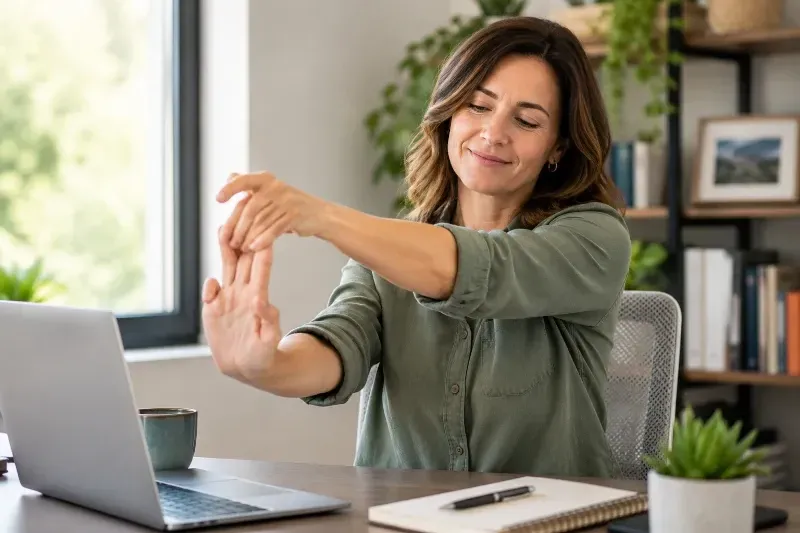
Stretches for carpal tunnel should target the forearm, wrist, fingers, and thumb to help flexor tendons glide more freely.
The best stretches for carpal tunnel focus on the flexor tendons — the long tendons that run from the forearm through the wrist and into the fingers. These tendons help you curl your fingers, grip objects, and use your hand throughout the day.
When carpal tunnel symptoms develop, these tendons can become irritated, restricted, and crowded inside the carpal tunnel space. Proper stretching helps keep them moving smoothly while reducing stiffness, pressure, and discomfort.
Stretches for carpal tunnel
work best when they target the flexor tendons in the forearm, wrist, hand, fingers, and thumb. The most useful stretches include push-out stretches, stop stretches, prayer stretches, and thumb stretches. For mild or moderate symptoms, they should be done several times per day and combined with proper night bracing.
People Also Ask
What are the best stretches for carpal tunnel?
The best stretches for carpal tunnel target the flexor tendons in the forearm, wrist, fingers, and thumb. Useful options include push-out stretches, stop stretches, prayer stretches, and thumb stretches.
How often should I do carpal tunnel stretches?
For mild or moderate symptoms, carpal tunnel stretches can be done every 2 to 3 hours. More severe symptoms may require stretching about once per hour, as long as the stretches are gentle and do not increase pain.
Can stretching cure carpal tunnel?
Stretching may help mild or moderate carpal tunnel symptoms by improving tendon movement and reducing stiffness. More advanced symptoms usually need additional treatment, such as night bracing and myofascial release therapy.
Should I stretch if my hand is numb?
Gentle stretching may help if numbness is mild, but stretching should not cause sharp pain, worsening numbness, or increased tingling. If symptoms are severe, frequent, or worsening, the underlying pressure on the median nerve should be addressed.
Why Stretches Help Carpal Tunnel
Stretches for carpal tunnel are most helpful when they focus on the
flexor tendons. These tendons pass through the same narrow wrist space as the median nerve. When the tendons become irritated, swollen, stiff, or restricted, they can increase crowding inside the carpal tunnel.
Good stretching helps the tendons move more freely through the wrist and hand. This matters because healthy tendon gliding can reduce stiffness, improve motion, and support normal fluid movement in the tissues.
The right stretches may help:
Carpal tunnel stretches are not meant to be aggressive. They should feel like a firm, comfortable stretch — not sharp pain, burning, or increased numbness.
Best rule of thumb:
Stretches for carpal tunnel should feel helpful, not harmful. If a stretch increases numbness, tingling, or pain, reduce the force or stop that stretch.
Before You Start Stretches for Carpal Tunnel
For mild or moderate carpal tunnel symptoms, do these stretches every 2 to 3 hours during the day. If symptoms are severe, they may need to be done more often — about once every hour — as long as they remain gentle and comfortable.
The stretches should be done as a complete set because each one targets a different area. One stretch focuses more on the fingers. Another targets the wrist. Another reaches deeper into the forearm. The thumb stretch is also important because the thumb is often one of the most affected fingers in
carpal tunnel syndrome.
The full routine only takes about a minute. The key is consistency. Many people get better results by setting a phone timer or reminder so they do not forget to stretch during the day.
Each of the following stretches targets a different part of the flexor tendon pathway. Together, they create a more complete stretching routine for carpal tunnel symptoms.
Finger Interlace Stretch (Push-Out Stretch) for Carpal Tunnel
Stop Stretch for Carpal Tunnel
Prayer Stretch for Carpal Tunnel
Thumb Stretch for Carpal Tunnel
Not Sure How Severe Your Carpal Tunnel Is?
Stretches may help mild or moderate symptoms, but more advanced carpal tunnel usually needs a stronger treatment plan.
Test Your Severity
Why Night Bracing Matters
During a stretching program, it is usually wise to wear a
proper carpal tunnel night brace while sleeping. This helps prevent the wrist from bending too far forward or backward during the night.
That matters because many people unknowingly sleep with the wrist bent. This position can increase pressure inside the carpal tunnel and make morning numbness, tingling, or pain worse.
However, not every wrist brace is useful for carpal tunnel. A proper carpal tunnel brace should hold the wrist in a neutral position without forcing the hand into an awkward angle.
Also, a brace should usually not be worn during the daytime while using the hand. Wearing a brace while working can make the hand fight against the brace, adding extra strain instead of allowing the tissues to recover.
Important:
Stretches for carpal tunnel work best when they are paired with proper night bracing and therapy that addresses tendon restriction, swelling, and pressure around the median nerve.
Summary
Stretches for carpal tunnel should target the entire flexor tendon pathway — from the forearm to the wrist, hand, fingers, and thumb. The push-out stretch, stop stretch, prayer stretch, and thumb stretch each address a different part of that pathway.
For mild or moderate symptoms, doing these stretches every 2 to 3 hours may help reduce stiffness and improve tendon movement. More severe symptoms may need more frequent stretching, along with night bracing and myofascial release therapy.
The best results come from consistency.
A one-minute routine done several times per day is more useful than a longer routine done only once in a while.
If symptoms continue worsening despite stretching, evaluation and additional treatment may be necessary.
Key Takeaways
- Stretches for carpal tunnel should target the forearm, wrist, fingers, and thumb.
- The best routine includes push-out, stop, prayer, and thumb stretches.
- Each stretch should be gentle and held for about 5 seconds.
- Mild or moderate symptoms may improve with frequent daily stretching.
- Night bracing and myofascial release therapy can improve results.
About Dr. Zannakis